
Top Milled Parts for Precision Manufacturing and Their Applications
2026-11-02
Precision manufacturing demands components that hit tolerances most shops can only dream about. From aerospace brackets to medical device housings, milled parts are the quiet backbone of modern engineering—yet not all machined features are created equal. In this guide, we break down the top milled parts driving today’s tightest industries, along with the real-world applications that depend on them. Whether you're prototyping a complex geometry or scaling production, understanding these workhorses—and partnering with a supplier like BOYIKUN who lives and breathes micron-level accuracy—could be the difference between a good run and a flawless one. Let’s cut through the noise and get to the metal.
Micro-milled titanium parts for steady surgical robot arms
The quiet hum of a surgical robot arm hides a brutal truth: every tremor in its joints becomes a cut inside a patient. Micro-milled titanium is the quiet fix for that. Unlike bulky machined brackets, these parts carry their strength in sub-millimeter ribs and tapered pockets, keeping mass low while stiffness stays stubbornly high. The process carves Grade 5 titanium with end mills barely thicker than a human hair, leaving surface finishes that grip bone screws without galling or fretting over thousands of autoclave cycles.
What gets tricky is that titanium doesn't care about your deadlines. It work-hardens if you linger, laughs at coolant that isn't dialed in just right, and punishes any tool runout with chipped edges and scrapped blanks. But the payoff comes when those tiny dovetail slides and zero-backlash gear housings drop into place, each one within five microns of nominal. That's when the arm stops buzzing, the camera stops drifting, and the surgeon stops thinking about the machine at all.
You won't find these parts on a shelf. Each one starts as a solid block of aerospace-grade titanium, then loses eighty percent of its weight to micro-milling passes that take hours, not minutes. The fixtures have to be as clever as the parts themselves — vacuum chucks, sacrificial tabs, and in-process probing that corrects thermal drift before it becomes a dimension. It's slow, quiet work, but surgical robots don't earn their steady hands any other way.
Replacing welded assemblies with custom milled brackets
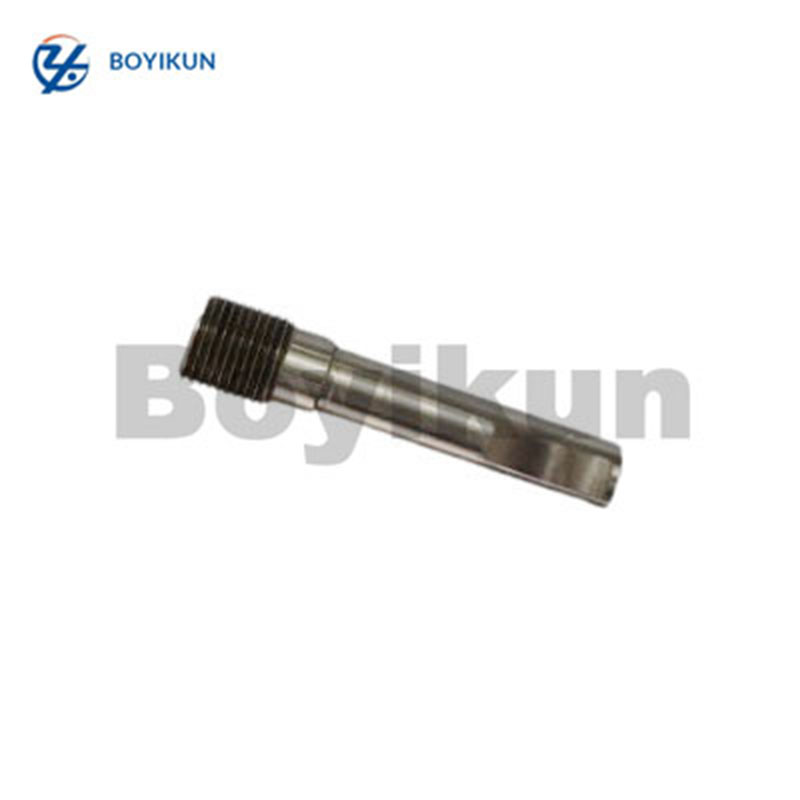
Traditional welded assemblies depend on sequential manual welding, heat distortion, stress relief, and post-weld machining to reach acceptable tolerances. Replacing them with custom milled brackets cuts those steps by producing a single-piece structure from billet or plate. Without weld seams, the heat-affected zones that typically become fatigue and crack initiation points are absent, so the bracket can have thinner sections in low-stress areas while retaining thicker bosses exactly where loads concentrate.
The machining route also tightens positional accuracy. A welded fixture may drift by half a millimeter due to thermal expansion during welding, but a milled bracket can hold bore-to-bore distances and mounting face flatness within ±0.05 mm without secondary shimming. That matters when brackets locate sensors, actuators, or suspension pickup points. Designers can machine threaded holes, press-fit bushings, or alignment features in the same setup, reducing part count and assembly labor.
Cost comparison shifts depending on volume. For one-off or low-volume production, custom milling avoids building and maintaining welding jigs, and material waste from plate stock is often lower than the overhead of handling multiple welded subcomponents. At higher volumes, upfront programming and machine time should be weighed against long-term savings from fewer quality checks and rework caused by weld distortion and residual stress.
Five-axis milling opens up geometries injection molding can't handle
Five-axis milling breaks the mold by producing complex, undercut, and deeply contoured shapes that would be impossible to eject from an injection mold. Unlike traditional three-axis machining, the additional two rotary axes allow the cutting tool to approach the workpiece from virtually any angle, creating intricate internal cavities, variable draft angles, and smooth blended surfaces without the need for complex multi-part tooling.
This capability becomes critical when designing parts with organic, ergonomic surfaces or aerodynamic profiles, such as impellers, turbine blades, and medical implants. Injection molding forces designers to simplify geometry for moldability, but five-axis milling removes that constraint, enabling monolithic parts with continuous curvature and no parting lines. The result is stronger, lighter components that require less assembly and exhibit superior performance.
For low to medium production runs, five-axis milling also avoids the high upfront cost and long lead times of injection mold fabrication. Designers can iterate quickly, making direct revisions to the CAM model without waiting for new mold cores. This flexibility makes five-axis milling the go-to choice for prototyping complex parts and for final production when true geometric freedom outweighs the per-piece economics of molding.
Milled aluminum housings that manage heat in electric vehicles
Electric vehicle batteries and power electronics hate temperature swings. A housing carved from a single billet of aluminum does more than hold components in place—it draws heat away from hot spots and spreads it across a larger surface where airflow or coolant can whisk it away. The milling process leaves thin, precisely spaced fins and internal channels that mass-produced castings simply cannot replicate, giving engineers direct control over where heat flows and how fast it leaves the pack.
Unlike stamped or welded enclosures, a milled housing eliminates internal voids and micro-cracks that act as thermal barriers. The metal stays dense and uniform, so heat moves through it without hitting dead zones. On a hot day or during a fast charge, that difference shows up as lower peak temperatures and a more even thermal map across the cells—two things that directly extend battery life and keep power output stable.
The real advantage comes when designers push the geometry. Curved internal walls, tapered ribs, and integrated cooling galleries can all be machined into the same block, creating a housing that fits the pack like a glove instead of a box. That kind of tailored thermal management is hard to achieve any other way, and it is one reason milled aluminum housings are showing up in more high-performance EVs where every degree matters.
How tolerance stacking guides multi-part fixture design in milling
When a fixture holds several workpieces at once, the individual machining tolerances don't exist in isolation. Each locating surface, clamp position, and datum reference adds a small deviation, and these errors accumulate as the parts interact within the same setup. Tolerance stacking analysis forces the designer to map that chain early, identifying which features control the final machined dimension and which ones merely add noise. In multi-part milling fixtures, a well-calculated stack converts what could be a scattered scatter of cut variations into a predictable band, letting you decide whether to tighten one critical locator or relax another without chasing invisible root causes later.
Practical fixture design often starts by reducing the number of contributing surfaces. If every part references the same machined pocket or a common rail, the stack shortens, and the variation between parts drops sharply. But that simplification comes with trade-offs: a shared rail may need a surface finish and flatness spec that single-part fixtures never demand. Tolerance stacking guides the choice between using spring-loaded pushers, fixed stops, or self-centering elements, because each mechanism introduces a different type of accumulated error. For example, a fixed stop gives a hard datum but forces the operator to load parts against it consistently, while a self-centering mechanism splits the tolerance equally but can hide a skewed placement if the part itself is not square.
The real value of tolerance stacking shows up after the first few runs. Instead of adjusting fixture components blindly, the machinist can look at which dimensions drift together and which stay independent, then return to the original stack calculation to see where the dominant term lies. That loop, between predicted accumulation and measured result, tightens the fixture over time without over-constraining every part. In milling, where vibration and thermal growth already shift dimensions by a few microns, a fixture built from a deliberate tolerance stack is easier to trust under load, easier to modify when a new part variant appears, and far less likely to produce a batch where every piece is just slightly out of spec in the same direction.
Why medical startups prefer milled PEEK over metal alternatives
Startups often discover that machining PEEK beats shaping metal on both cost and time. The material can be milled at high speeds without sacrificing tight tolerances, which means a prototype that might take days in titanium comes off the machine in hours. There is also less need for secondary finishing like polishing or passivation, so small teams can iterate faster without burning through a limited budget.
Unlike metals, PEEK has a density close to bone and can be tailored with carbon fiber or other additives to match specific mechanical needs. This opens the door to implants and surgical tools that feel less foreign inside the body, while still holding up under repeated stress. For a young company, that combination of biocompatibility and easy machining shortens the path from CAD file to first clinical test.
A less obvious advantage is the supply chain. Medical-grade metals often come with long lead times and unpredictable pricing, especially for small batch orders. Milled PEEK, however, can be sourced in rod or sheet form from multiple vendors, and the chips from machining can sometimes be recycled. That flexibility gives startups a real edge when they need to pivot a design or scale from ten parts to a few hundred without renegotiating contracts.
FAQ
Milled parts often serve as the backbone of complex assemblies because they can hold tight tolerances and offer repeatable geometry. In industries like aerospace or medical devices, even a slight dimensional drift can cause failures, so milling provides the control needed to match design intent exactly.
Common examples include mounting brackets, valve bodies, heat sinks, and optical housings. These components typically need flatness, perpendicularity, and hole patterns that line up perfectly with mating parts. Milling allows for those features to be produced in a single setup.
Heat sinks rely on thin fins and flat base surfaces to pull heat away from electronics. Milling can create fine fin spacing and a uniform contact surface, which improves thermal transfer. Tight control over fin height and base flatness helps avoid hot spots in power-dense devices.
Aluminum is lightweight, machines quickly, and resists corrosion. Grades like 6061 and 7075 strike a balance between strength and workability, making them practical for everything from drone brackets to medical instrument bodies. The material also accepts anodizing well, which adds surface hardness.
Fixture plates give a stable reference surface for holding workpieces during secondary operations. Milling ensures the holes, slots, and datum edges are accurately positioned, so every part loaded onto the plate sits in the same place. This reduces setup time and improves batch consistency.
Yes, with the right material and finishing choices. Stainless steel or titanium milled components, for example, hold up against corrosion, high temperatures, and mechanical stress. They are frequently found in oil and gas tools, marine hardware, and surgical instruments where failure is not an option.
With modern CNC milling centers, tolerances of plus or minus 0.001 inches are common, and some tight features can be held to plus or minus 0.0002 inches. The exact capability depends on part geometry, tooling, and thermal stability, but it is enough for most demanding mechanical and optical assemblies.
Prototyping often focuses on speed and design validation, so machinists might use softer materials or leave extra stock for adjustments. Production milling prioritizes repeatability, so processes are locked down, tool wear is monitored closely, and inspection points are added to keep every piece within spec.
Conclusion
Precision manufacturing relies on milled components that push beyond conventional limits. In surgical robotics, micro-milled titanium parts deliver the stiffness and biocompatibility needed for steady, repeatable arm movements during delicate procedures. The same attention to detail appears in structural brackets: many assemblies once welded are now machined from solid stock, reducing distortion and improving alignment. Five-axis milling further expands possibilities, producing undercuts and organic contours that injection molding simply cannot replicate. Meanwhile, electric vehicle manufacturers depend on milled aluminum housings to channel heat away from batteries and power electronics, keeping thermal loads in check without adding excessive weight.
Designing these parts is never just about geometry. Tolerance stacking dictates how multiple milled components come together in a fixture, and engineers often simulate the cumulative variation before cutting metal to ensure every locating feature holds position under load. Material selection matters equally: medical startups increasingly choose milled PEEK over metals because it offers chemical resistance, radiolucency, and a strength-to-weight profile that suits implants and surgical tools. Across all these examples, the common thread is a shift from off-the-shelf or molded alternatives to purpose-milled parts that solve specific thermal, mechanical, and regulatory challenges.
Contact Us
Contact Person: Xianchen Hu
Email: [email protected]
Tel/WhatsApp: 86-13248645200
Website: https://www.hexnb.com/