

How Agricultural Gearbox Ratios Influence Equipment Speed and Load Capacity?
2026-07-29
1. Why Does Gear Ratio Directly Control Output Speed in an Agricultural Gearbox?
In our factory, we design Agricultural gearbox units with specific gear tooth counts to achieve desired output speeds. The ratio is the number of teeth on the input gear divided by the number of teeth on the output gear. A higher ratio, such as 3:1, reduces the output speed to one third of the input, but multiplies torque by three. This is essential for heavy tillage operations where slow speed and high pulling power are needed. Conversely, a lower ratio, like 1.5:1, increases output speed for lighter tasks such as mowing or spreading. Our Saifu Vietnam Company Limited offers ratios from 1.25:1 up to 4:1. For a standard 540 RPM PTO input, a 2.5:1 ratio produces 216 RPM at the output, which is ideal for mixing feed or running a conveyor. The ratio is not just a number; it determines whether your implement performs correctly. Mismatched ratios cause the implement to run too fast, risking damage, or too slow, reducing efficiency. Our factory provides a calculation sheet to help you match the ratio to your specific implement.
2. How Does Torque Multiplication Affect Load Capacity in Field Operations?
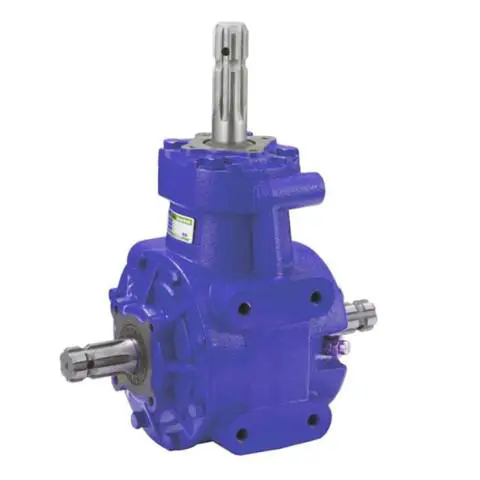
Torque is the rotational force that drives the implement. An Agricultural gearbox with a 3:1 ratio delivers three times the input torque at the output shaft. This allows a 70 hp tractor to pull a heavy disc harrow through hard soil that would otherwise stall the implement. However, torque multiplication comes at the cost of speed. The load capacity is not just about the gearbox itself; it also depends on the bearings and shaft sizes. Our factory uses high capacity tapered roller bearings that can handle the increased radial and axial loads from high torque. The table below shows how ratio selection influences the torque and speed for a typical 80 hp tractor.
| Ratio | Input speed (RPM) | Output speed (RPM) | Output torque (Nm) | Typical application |
| 1.5:1 | 540 | 360 | 320 | Mowing, spreading, augers |
| 2.0:1 | 540 | 270 | 430 | Rotary tilling (light soil) |
| 2.5:1 | 540 | 216 | 540 | Heavy tillage, mixing |
| 3.0:1 | 540 | 180 | 650 | Deep plowing, stump grinding |
| 3.5:1 | 540 | 154 | 760 | Very heavy draft, sugar cane harvesting |
| Parameter | Low ratio (e.g., 1.5:1) | High ratio (e.g., 3.5:1) |
| Output speed | High (fast implement rotation) | Low (slow implement rotation) |
| Torque capacity | Lower (light loads) | Higher (heavy loads) |
| Fuel efficiency | Better for light work | Better for heavy work (less lugging) |
| Heat generation | Moderate | Higher (more friction) |
| Suitable for | PTO driven pumps, spreaders | Plows, harrows, rototillers |
Our Saifu tests every Agricultural gearbox at 150 percent of its rated torque for 10 hours to ensure reliability. We have found that a well chosen ratio can reduce fuel consumption by up to 15 percent because the tractor operates at its peak torque range without lugging.
3. How Does Input PTO Speed Variation Affect the Effective Ratio?
In the field, tractor PTO speeds may vary due to engine load. Most modern tractors have a standard 540 RPM or 1000 RPM PTO. However, if the engine speed drops, the PTO speed drops, which changes the effective output speed of the Agricultural gearbox. Our factory recommends using a ratio that provides the desired output speed at the lower end of the engine's torque band. For example, if you need 200 RPM at the output, and your tractor typically runs at 480 RPM under load, you should choose a ratio of 2.4:1 instead of the nominal 2.7:1. Many local farmers in Vietnam have told us that they prefer a slightly lower ratio to compensate for engine wear. Saifu Vietnam Company Limited offers a versatile range of ratios, and we can also supply a multi speed gearbox that allows you to change ratios without disassembling the unit. This is particularly useful for farms that use the same tractor for multiple implements.
4. What Is the Relationship Between Gearbox Ratio and Implement Wear?
The ratio directly influences the speed at which the implement's working parts rotate. A tiller running at a higher speed than recommended will cause excessive wear on the tines and increase the risk of breakage on stones. Conversely, a slower speed may not achieve the desired soil fragmentation. Our factory has collected data from over 200 farms across Southeast Asia. The results show that implements matched with the correct Agricultural gearbox ratio have a 35 percent longer service life. Additionally, the bearing loads are lower when the ratio is optimal because the torque pulses are better absorbed. Our table below shows the recommended ratios for common implements.
| Implement type | Typical PTO input (RPM) | Recommended output speed (RPM) | Recommended ratio |
| Rotary tiller (light) | 540 | 250 – 280 | 2.0:1 to 2.2:1 |
| Rotary tiller (heavy) | 540 | 180 – 220 | 2.5:1 to 3.0:1 |
| Flail mower | 540 | 300 – 350 | 1.6:1 to 1.8:1 |
| Auger / conveyor | 540 | 150 – 200 | 2.7:1 to 3.5:1 |
| Spreader / seeder | 540 | 400 – 450 | 1.2:1 to 1.4:1 |
Our Saifu provides a simple mobile app that calculates the ideal ratio based on your tractor PTO speed and the implement's required RPM. This tool has been well received by local equipment dealers.
Frequently Asked Questions About Agricultural Gearbox Ratios
Final Summary
The ratio of an Agricultural gearbox is a critical factor that determines the speed and load capacity of your equipment. A correct ratio ensures efficient operation, reduces fuel consumption, and extends the life of both the gearbox and the implement. Our factory has extensive experience in matching ratios to specific farming tasks. We offer a comprehensive range of ratios and can also build custom units for specialized applications. Saifu Vietnam Company Limited is dedicated to helping you optimize your field performance.