

How Can Proper Heat Treatment Improve Ring Gear Strength and Durability?
2026-01-19
In drivetrain and power transmission systems, ring gears are constantly exposed to cyclic loads, shock torque, and long duty cycles. Heat treatment directly determines how well a gear resists tooth root fatigue, surface pitting, and sudden overload. In our production workflow, thermal processing is not an optional step but a structural necessity. Through controlled heating and cooling, the steel microstructure transforms to support higher torque density and improved dimensional stability. When engineered correctly, a single Precision Gear can handle sustained loads without deformation, helping our customers reduce downtime and maintenance frequency.
From automotive differentials to industrial reducers, local buyers expect heat-treated ring gears to perform consistently under SAE and AGMA standards. Our engineering team designs each thermal profile to match real-world operating stress rather than laboratory assumptions.
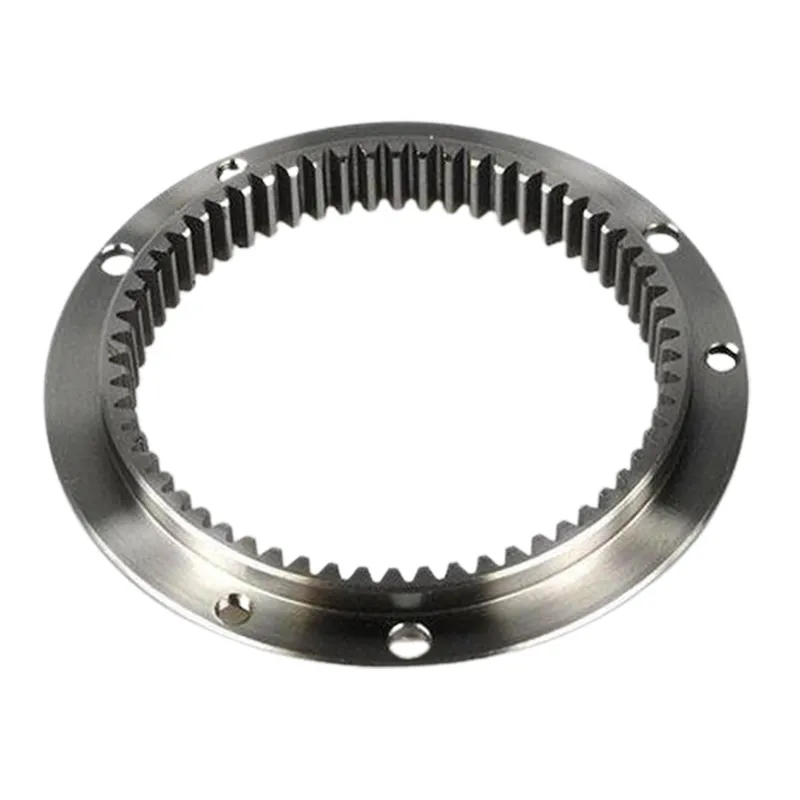
How Do Different Heat Treatment Methods Enhance Ring Gear Performance?
Different applications require different heat treatment solutions. Selecting the wrong process can lead to brittle teeth or insufficient hardness. Our factory applies multiple proven methods based on material grade, module size, and target hardness. Through years of production experience at Raydafon Technology Group Co.,Limited, our engineers have refined these processes to meet demanding North American and European market expectations.
| Heat Treatment Process | Typical Hardness Range | Performance Benefit | Recommended Applications |
| Carburizing | HRC 58 to 62 | High surface wear resistance with tough core | Automotive ring gears, heavy-duty reducers |
| Induction Hardening | HRC 50 to 58 | Localized hardness with minimal distortion | Large-diameter industrial ring gears |
| Nitriding | HV 900 to 1100 | Excellent fatigue and corrosion resistance | High-precision, low-noise gear systems |
By matching the right process to each Precision Gear design, our factory ensures optimal hardness distribution and long-term reliability.
How Does Metallurgical Control Improve Tooth Strength and Fatigue Life?
Heat treatment is not just about hardness values. Metallurgical control determines how grain structure, residual stress, and core toughness interact under load. Our production engineers monitor carbon diffusion depth, quenching media temperature, and tempering cycles to stabilize tooth geometry. This approach allows our products to maintain contact accuracy even after thousands of operating hours.
In Precision Gear manufacturing, tooth bending fatigue is one of the most common failure modes. Through optimized thermal cycles, our solutions improve fatigue strength by enhancing martensitic transformation while retaining ductile cores. This balance allows our customers to run higher torque ratings without sacrificing service life.
How Do Material Selection and Heat Treatment Work Together?
Material selection and heat treatment must be engineered as a single system. Alloy steels such as 20CrMnTi, 42CrMo, and 18CrNiMo7-6 respond differently to thermal processing. Our engineering team selects steel grades based on expected torque, shock loading, and environmental exposure. At Raydafon Technology Group Co.,Limited, our material sourcing and heat treatment planning are aligned from the earliest design stage.
| Material Grade | Heat Treatment Method | Core Toughness | Typical Use Case |
| 20CrMnTi | Carburizing and quenching | High | Automotive and agricultural ring gears |
| 42CrMo | Quenching and tempering | Medium to high | Industrial transmission systems |
| 18CrNiMo7-6 | Deep carburizing | Very high | High-load precision gearboxes |
By coordinating metallurgy and heat treatment, our factory delivers consistent mechanical performance across every Precision Gear batch.
How Does Quality Control Verify Heat Treatment Effectiveness?
Heat treatment performance must be measurable and repeatable. Our quality control process includes hardness testing, case depth inspection, and microstructure analysis. Each production lot is sampled to confirm compliance with customer specifications and industry norms. Our inspection procedures follow ASTM and ISO practices commonly recognized by local OEMs.
For every Precision Gear leaving our facility, our documentation provides traceability from raw material through final inspection. This transparency helps our customers meet internal audit and certification requirements with confidence.
FAQ
How Can Proper Heat Treatment Improve Ring Gear Strength and Durability?
Proper heat treatment increases surface hardness while maintaining a tough core, allowing ring gears to resist wear, fatigue cracking, and impact loads over long operating cycles.
How Can Proper Heat Treatment Improve Ring Gear Strength and Durability in High-Torque Systems?
In high-torque applications, controlled carburizing or induction hardening improves tooth root strength and reduces the risk of sudden failure under peak load conditions.
How Can Proper Heat Treatment Improve Ring Gear Strength and Durability for Precision Assemblies?
For precision assemblies, optimized thermal cycles minimize distortion and residual stress, preserving gear accuracy and extending service life in noise-sensitive systems.
Conclusion
When heat treatment is engineered correctly, ring gears deliver measurable value through extended service intervals, lower maintenance costs, and improved system efficiency. At Raydafon Technology Group Co.,Limited, our factory combines metallurgical expertise with production discipline to support demanding applications worldwide. If you are sourcing a reliable Precision Gear solution designed for strength and durability, our technical team is ready to support your project requirements. Contact us today to discuss specifications, customization options, and lead times.