

How Do Engineers Choose the Right Precision Gear Type for Machinery?
2026-08-10
1. Why Does Gear Geometry Define the Application for Precision Gear?
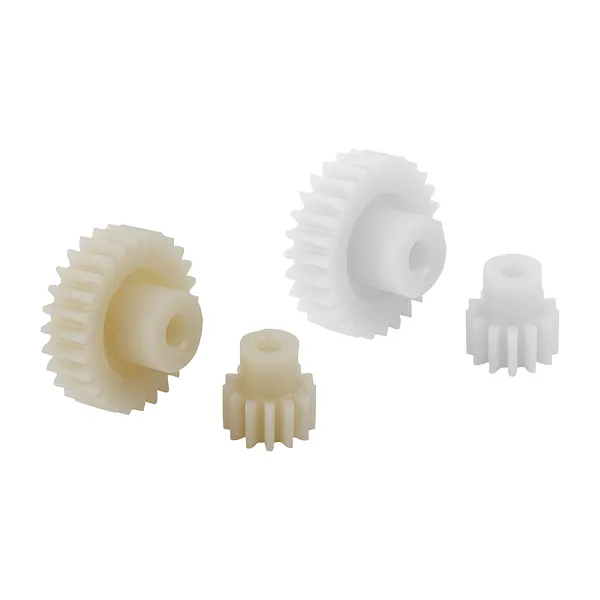
In our factory, we have produced thousands of Precision Gear sets for industries ranging from robotics to heavy earthmoving. The first selection criterion is tooth geometry. Spur gears are the simplest, with straight teeth parallel to the shaft. They are efficient but produce noise at high speeds. Helical gears have angled teeth that engage gradually, which reduces vibration and allows for higher speeds. Our Raydafon Technology Group Co.,Limited often recommends helical Precision Gear for applications like industrial gearboxes where noise reduction is important. Bevel gears are used when the shafts are at an angle, typically 90 degrees. For a machine tool spindle, a spiral bevel Precision Gear provides smooth motion and high load capacity. Choosing the wrong geometry leads to premature wear or excessive heat. We have seen engineers select spur gears for high speed conveyors, only to face noise complaints and frequent lubrication changes. Understanding the load direction and speed is the first step.
2. How Do Load and Torque Requirements Influence the Choice of Precision Gear?
Load is not just about torque; it includes shock loads and cyclic stress. Our factory performs finite element analysis for each Precision Gear design to calculate the maximum bending stress and contact stress. For high torque applications, such as wind turbine pitch drives, we use a planetary Precision Gear arrangement because multiple gears share the load. For a robotic arm, where precision and low backlash are critical, a harmonic or cycloidal Precision Gear is preferred. The table below shows how we classify gear types based on load parameters.
| Gear type | Typical torque range (Nm) | Max speed (RPM) | Load distribution |
| Spur gear | 10 – 5000 | Up to 5000 | Single pair mesh |
| Helical gear | 50 – 20000 | Up to 8000 | Multiple teeth engaged gradually |
| Bevel gear (spiral) | 100 – 15000 | Up to 4000 | Angular shafts |
| Planetary gear | 500 – 50000 | Up to 3000 | Shared by 3 or more planets |
| Application type | Recommended Precision Gear | Key selection reason |
| Machine tool spindle | Helical or spiral bevel | Low noise, high rigidity |
| Automation robotics | Planetary or harmonic | Zero backlash, compact size |
| Agricultural implement | Spur or helical | Cost effective, robust |
| Wind turbine pitch drive | Planetary | High torque density, long life |
Our engineers also consider the service factor, which accounts for the nature of the driven load. For example, a Precision Gear driving a crusher has a service factor of 1.5 to 2.0, while a smooth conveyor has 1.0. This factor multiplies the required torque, effectively uprating the gear. We have a database of over 200 application profiles to help our clients make the correct selection.
3. What Role Does Precision and Backlash Play in Gear Selection?
Backlash is the clearance between mating teeth. For many industrial applications, standard backlash of 0.1 to 0.2 mm is acceptable. However, for CNC machines and robotics, low backlash (below 0.03 mm) is essential to maintain positional accuracy. Our factory manufactures Precision Gear with adjustable backlash by using eccentric bearing housings. For applications requiring zero backlash, we use a split gear design or a preloaded planetary gearbox. The required accuracy class according to DIN or AGMA standards is a key factor. For a high speed turbine gearbox, we recommend AGMA class 12 or higher, which involves profile and lead modifications. Our Raydafon can produce up to class 14 for special projects. The cost increases exponentially with precision, so engineers must balance accuracy with budget. We often advise that a Precision Gear with slightly higher backlash but better thermal stability may be more suitable for outdoor equipment where temperature swings are large.
4. How Do Material and Heat Treatment Affect the Longevity of a Precision Gear?
The material selection is as critical as geometry. Our factory uses case hardening steels like 18CrNiMo7‑6 for heavy duty Precision Gear. The carburizing process creates a hard surface (58‑62 HRC) with a tough core. For corrosive environments, we use stainless steel or nickel alloys. The table below compares common materials used in our Precision Gear production.
| Material | Surface hardness (HRC) | Core hardness (HRC) | Typical application |
| 20MnCr5 (case hardened) | 58 – 62 | 30 – 40 | Automotive gearboxes |
| 18CrNiMo7‑6 (case hardened) | 58 – 62 | 35 – 45 | Heavy machinery, wind turbines |
| 42CrMo4 (through hardened) | 40 – 45 | 40 – 45 | Low speed, high load |
| Nitriding steel (EN 40B) | 60 – 65 (surface) | 28 – 35 | Wear resistant, minimal distortion |
Heat treatment also determines residual stresses. Our factory uses a vacuum furnace to minimize distortion. We also perform shot peening to increase fatigue life by up to 30 percent. For a Precision Gear operating in a gear pump, the material must also have good scuffing resistance. We have developed a proprietary micro‑alloyed steel that outperforms standard grades in high slip applications. The choice of material directly affects the gear's life cycle cost.
Frequently Asked Questions About Choosing Precision Gears
Final Summary
Selecting the right Precision Gear is a systematic process that considers geometry, load, backlash, and material. Each factor interacts with the others, and a balanced approach yields the best performance and cost. Our factory has extensive experience in manufacturing Precision Gear for diverse applications, and we offer full engineering support from selection to production. We encourage engineers to share their operating conditions with us early in the design phase. Raydafon Technology Group Co.,Limited is committed to delivering gears that meet your exact requirements.