

How Do Planetary Gearboxes Support Renewable Energy Applications?
2026-09-03
Walk up to a modern wind turbine, and you will see the nacelle yawing to face the wind. Look inside, and you will find a Planetary Gearbox making that movement possible. The same technology drives solar trackers that follow the sun across the sky. In both cases, the requirement is the same: high torque density, precise positioning, and reliable operation in harsh outdoor conditions. A planetary gearbox is not always the obvious choice. Sometimes a worm gear or a helical gearbox is simpler. But in renewable energy applications, where weight, space, and efficiency are critical, the planetary design offers advantages that are difficult to ignore.
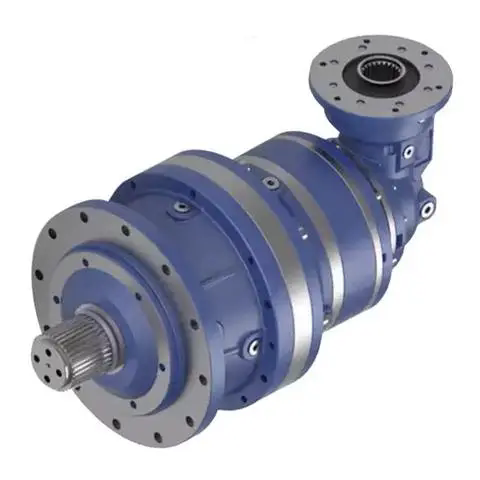
1. What Makes the Planetary Design Suitable for Wind Turbine Pitch Control?
Wind turbine pitch control is one of the most demanding gearbox applications. The pitch mechanism must adjust the blade angle quickly and precisely to optimize power capture and limit loads during gust conditions. The gearbox must operate reliably in temperatures ranging from -30°C to +50°C, with exposure to salt spray in offshore installations. A Planetary Gearbox meets these demands because it offers three key characteristics. First, the coaxial design allows the gearbox to fit within the confined space of the blade hub. Second, the load sharing among multiple planets provides high torque capacity in a compact package. Third, the high efficiency reduces the power required from the pitch motor, which is important for backup battery systems. In our factory, we manufacture Planetary Gearbox units specifically for pitch control applications. The gearbox is designed with a fail safe brake that locks the blade in position during power loss. The lubrication system is sealed to prevent contamination and uses a synthetic oil that maintains viscosity at low temperatures.
2. How Does a Planetary Gearbox Support Solar Tracker Positioning?
Solar trackers, both single-axis and dual-axis, require gearboxes that can hold position against wind loads while moving smoothly over a limited angular range. A typical single-axis tracker moves through about 120 degrees per day, at a speed of roughly 0.02 RPM. The gearbox must have low backlash to ensure that the tracker points accurately at the sun. A Planetary Gearbox offers low backlash because the gear mesh is preloaded and the multiple planet gears distribute the load. This is important because a backlash of even 0.5 degrees can reduce energy capture by 1 to 2 percent over the course of a day. In our factory, we have tested Planetary Gearbox units for solar trackers and measured backlash of less than 0.1 degree.
The table below shows the key performance parameters for Planetary Gearbox units used in solar tracking applications.
| Parameter | Our Planetary Gearbox (solar tracker model) | Typical worm gear alternative |
| Backlash (arc minutes) | < 6 | 15 – 30 |
| Efficiency (at nominal torque) | 94 – 96% | 70 – 85% |
| Torque density (Nm per kg) | 180 – 220 | 80 – 120 |
| Holding torque capability | Self locking with brake | Self locking (inherent) |
| Service life (cycles, full range) | 50,000 | 10,000 – 20,000 |
The higher efficiency of the Planetary Gearbox reduces the power consumption of the solar tracker motor, which is important for large solar farms where the aggregate power draw of hundreds of trackers can be significant. The lower backlash also improves the accuracy of the tracking, which increases energy yield. Our Saifu Vietnam Company Limited has supplied Planetary Gearbox units for solar farms in Vietnam, Thailand, and India. The feedback from these projects has consistently highlighted the reliability and accuracy of the gearboxes.
3. What Are the Critical Design Parameters for Renewable Energy Gearboxes?
When selecting a Planetary Gearbox for a renewable energy application, there are five parameters that must be carefully evaluated. The first is the torque rating, which must be sufficient for the maximum expected wind or solar load. The second is the service life, which for a wind turbine is typically 20 years of continuous operation. The third is the operating temperature range, which must cover the environmental extremes of the installation site. The fourth is the sealing and corrosion protection, which is critical for offshore or coastal installations. The fifth is the redundancy and fail safe operation, which is required for safety critical applications like wind turbine pitch control.
The table below shows the typical values for these parameters in our Planetary Gearbox units for renewable energy applications.
| Design parameter | Wind turbine pitch control | Solar tracker (single-axis) | Solar tracker (dual-axis) |
| Nominal torque (Nm) | 2,000 – 8,000 | 500 – 2,000 | 800 – 3,000 |
| Service life (years) | 20 | 15 | 15 |
| Operating temperature | -30°C to +50°C | -20°C to +60°C | -20°C to +60°C |
| Sealing requirement | IP67 (temporary immersion) | IP65 (dust and water jets) | IP65 |
| Fail safe brake | Required (spring applied) | Optional | Optional |
Our factory designs Planetary Gearbox units with these parameters in mind. We use corrosion resistant materials, double lip seals, and a high quality synthetic oil that provides lubrication across the temperature range. The gearbox housing is protected with a two-part epoxy paint system that withstands salt spray testing to 1,000 hours.
4. What Are the Long-Term Reliability Considerations for Renewable Energy Installations?
Renewable energy installations are expected to operate for 20 to 25 years with minimal maintenance. This means that the Planetary Gearbox must be designed for long service life with limited lubrication changes. In our factory, we have tested Planetary Gearbox units under accelerated wear conditions that simulate 20 years of operation. The key factors affecting reliability are the bearing life, the gear tooth fatigue strength, and the seal durability. In our design, we use bearings that are rated for 100,000 hours of continuous operation at full load. The gears are case hardened to 58-62 HRC and ground to a surface finish of 0.4 Ra, which minimizes wear. The seals are made from a fluoroelastomer that is resistant to ozone, UV, and temperature extremes. We also provide a recommended maintenance schedule that includes oil sampling and analysis. Saifu has installed over 5,000 Planetary Gearbox units in renewable energy applications. The field return rate is less than 0.5 percent over the first 5 years of operation.
Frequently Asked Questions About Planetary Gearboxes in Renewable Energy
Summary for Renewable Energy Project Engineers
The Planetary Gearbox offers a combination of high torque density, low backlash, and high efficiency that makes it the preferred drivetrain solution for wind turbine pitch control and solar tracker positioning. The key to successful application is selecting the right design parameters: torque rating, service life, sealing, and braking. Our factory has the engineering expertise and manufacturing capacity to supply Planetary Gearbox units for renewable energy projects of any scale. Saifu Vietnam Company Limited is committed to providing reliable drivetrain solutions that contribute to the efficiency and longevity of renewable energy installations.