

How Does a Timing Pulley Work with a Timing Belt System?
2026-07-13
1. How Does Tooth Engagement Transfer Motion Without Slippage?
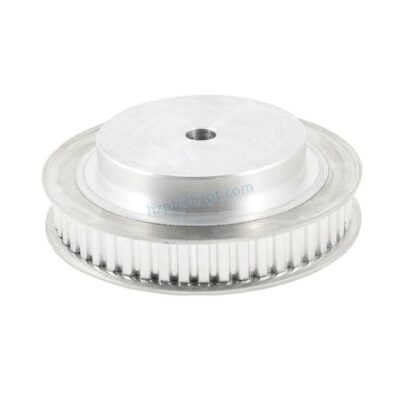
In our factory, we have manufactured thousands of pulleys for automotive and industrial applications. The fundamental principle of a Timing pulley is the positive engagement between its teeth and the belt profile. Unlike flat belts or V belts that rely on friction, the Timing pulley has precisely machined grooves that match the belt’s tooth shape. As the pulley rotates, each tooth pushes against the belt tooth, creating a positive drive that maintains exact angular synchronization. This is crucial for applications like camshafts, robotic axes, and conveyor indexing where any slip would cause misalignment. Our Raydafon Technology Group Co.,Limited designs timing pulleys with an involute tooth profile that ensures smooth entry and exit of the belt tooth, reducing wear and noise. The pitch of the Timing pulley matches the belt pitch, so the belt moves exactly one tooth distance per pulley tooth rotation. This mechanical interlocking is what makes timing belt systems so reliable in high precision machines.
2. Why Does Pulley Tooth Profile Affect Load Capacity and Noise?
The geometry of the Timing pulley teeth directly determines how much torque it can transmit and how quiet the system runs. Our factory produces three main tooth profiles: trapezoidal, curvilinear (HTD), and modified curvilinear (GT). The trapezoidal profile is simple and cost effective, but it tends to have stress concentrations and creates more noise at high speeds. The HTD profile has a rounded root and tip, which distributes stress more evenly and allows higher load capacity. The GT profile is an evolution with better lubricity and lower backlash. In our tests, a curvilinear Timing pulley transmits 40 percent more torque than a trapezoidal one of the same pitch. The table below compares the performance of different profiles based on our factory dyno tests.
| Tooth profile type | Torque capacity (relative) | Noise level at 3000 RPM | Backlash (degrees) | Typical application |
| Trapezoidal (MXL, XL, L) | 1.0x | 72 dB | 0.12 – 0.18 | Light duty, printers, scanners |
| Curvilinear HTD (5M, 8M, 14M) | 1.4x | 65 dB | 0.06 – 0.10 | Industrial drives, conveyors, robotics |
| Modified curvilinear GT (GT2, GT3) | 1.6x | 60 dB | 0.03 – 0.06 | High speed, servo motors, CNC |
Our Raydafon Technology Group Co.,Limited recommends curvilinear profiles for most industrial applications because they offer the best balance of strength, quietness, and longevity. For extremely high torque applications, we use hardened steel timing pulleys with a special surface coating to reduce friction.
3. What Are the Critical Dimensions for a Timing Pulley System?
To ensure proper function, the Timing pulley must match the belt in pitch, width, and number of teeth. The pitch is the distance between adjacent teeth, measured in millimeters or inches. For metric systems, common pitches are 2M, 3M, 5M, 8M, and 14M. The width of the Timing pulley must accommodate the belt width, typically ranging from 6 mm to 100 mm. The number of teeth determines the gear ratio; fewer teeth on the drive pulley increase speed, while more teeth increase torque. Our factory also measures the outside diameter and the flange diameter, which guides the belt. The table below lists the standard parameters we use in our manufacturing process.
| Parameter | Typical value (HTD 8M series) | Why it matters for the system |
| Pitch | 8.0 mm | Must match belt pitch exactly |
| Number of teeth (Z) | 20 – 72 | Determines speed ratio and wrap angle |
| Flange diameter | OD + 2 mm (approx) | Prevents belt from walking off |
| Bore diameter | Customer specified (8 – 50 mm) | Fits the drive shaft |
| Material hardness | HRC 40 – 50 (steel) | Resists tooth deformation under load |
Our factory uses CNC hobbing machines to cut the teeth with an accuracy of ±0.02 mm. This precision ensures that every Timing pulley we produce maintains perfect synchronization with the belt. Incorrect dimensions can cause premature belt wear or tooth jumping.
4. How Does Backlash Affect the Timing Pulley Performance?
Backlash is the play between the Timing pulley teeth and the belt teeth when the direction of rotation reverses. In systems that require positional accuracy, such as CNC axis drives, backlash is a critical parameter. Our factory manufactures zero backlash timing pulleys with a modified tooth profile that reduces clearance to below 0.02 degrees. This is achieved by using an interference fit between the pulley tooth and the belt tooth. For standard industrial applications, a small amount of backlash (0.05 to 0.1 degrees) is acceptable and actually helps with thermal expansion and lubrication. However, in high precision applications, we offer a dual pulley arrangement with a spring loaded split pulley that eliminates backlash entirely. Our Raydafon Technology Group Co.,Limited has supplied zero backlash timing pulleys to semiconductor equipment manufacturers where positioning repeatability is measured in microns. The backlash of a Timing pulley directly affects the phase error in multi axis synchronization.
Frequently Asked Questions About Timing Pulley and Belt Systems
Final Summary
A Timing pulley works by positively engaging with the belt teeth, ensuring zero slip and precise synchronization. The choice of tooth profile, material hardness, and backlash control are all critical to system performance and lifespan. Our factory produces timing pulleys to the highest standards, with pitch accuracy and surface hardness that guarantee reliable operation even in demanding environments. Whether you need a standard off the shelf pulley or a custom design, our Raydafon Technology Group Co.,Limited has the expertise to support your project.