

How Does Germany Zenith Block Machine Achieve High Precision Block Forming?
2026-08-06
1. Why Does the Servo Hydraulic System Ensure Consistent Compression Force?
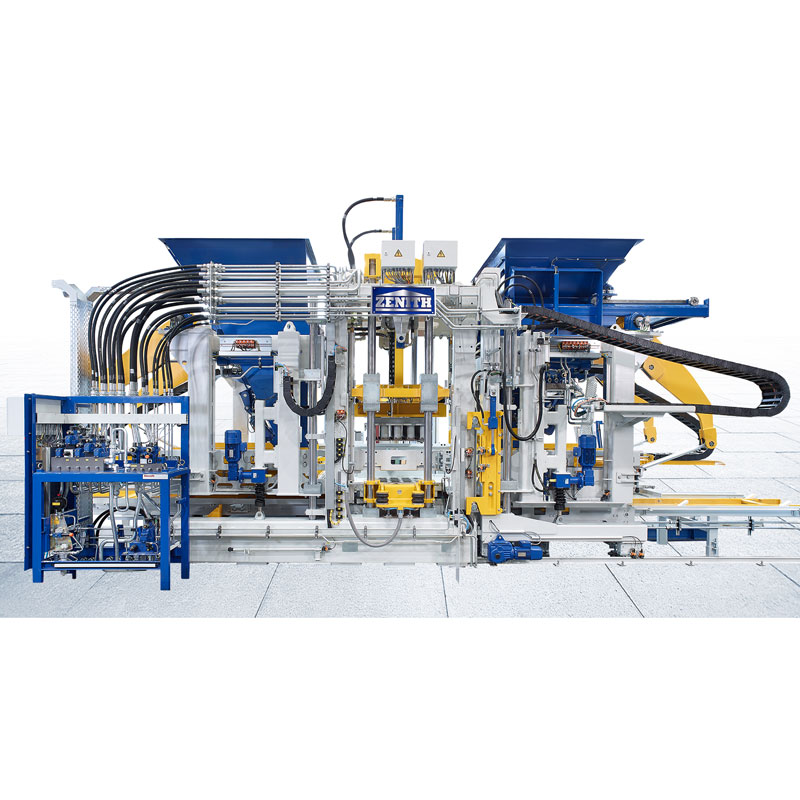
In our factory, we have tested many block machines over the years, and the Germany Zenith Block Machine stands out because of its closed loop servo hydraulic system. The system uses a high response proportional valve and a pressure transducer that continuously monitors the pressing force 1000 times per second. This means that when the mix consistency changes slightly, the machine adjusts the hydraulic pressure in real time to maintain a constant 280 tons of forming force. Our Quangong Machinery Co., Ltd. has documented that the force variation from block to block is less than 1.5 percent. This is significantly better than conventional open loop systems that can have 5 to 8 percent variation. For a hollow block, a consistent force ensures that the wall thickness and density are uniform, which directly translates to higher compressive strength and lower water absorption. The servo technology also reduces energy consumption because the pump only delivers flow when needed, rather than running continuously. Many local producers in Germany and Austria have confirmed that the Germany Zenith Block Machine produces blocks with a standard deviation of only 0.3 mm in height, which is remarkable for a high volume industrial process.
2. How Does the Vibration System Contribute to Dimensional Accuracy?
Precision block forming is not just about pressure; it is also about the way the material is settled before pressing. The Germany Zenith Block Machine features a dual shaft vibration system with independent frequency control. The upper vibrator operates at 50 to 65 Hz, while the lower vibrator runs at 40 to 55 Hz. This differential frequency creates a standing wave pattern that drives fine aggregates into the corners of the mold. Our factory has used high speed cameras to observe the material movement, and we found that the Germany Zenith Block Machine achieves a fill density variation of less than 0.5 percent across the mold cavity. This eliminates the common problem of uneven block edges. The vibration is also automatically adjusted based on the feedback from an accelerometer mounted on the mold table. When the mix is wetter, the vibration frequency increases slightly to prevent sticking. When the mix is drier, the amplitude increases to ensure compaction. This adaptive control is a key reason why the Germany Zenith Block Machine can produce blocks that meet the strictest European tolerances (DIN EN 771).
3. What Role Does the Mold Technology Play in Achieving Tight Tolerances?
The mold is the final shaping tool, and the Germany Zenith Block Machine uses molds manufactured with wire EDM (electrical discharge machining) to achieve a surface roughness of 0.8 Ra. This smooth finish reduces friction during stripping, preventing cracking. More importantly, the mold dimensions are ground to a tolerance of ±0.05 mm, which is far tighter than the typical ±0.2 mm found in standard machines. Our QGM also uses a hardened steel insert that resists wear, so the mold maintains its accuracy over millions of cycles. The table below compares the mold specifications of the Germany Zenith Block Machine with a standard industrial mold.
| Mold characteristic | Germany Zenith Block Machine | Standard industrial mold |
| Dimensional tolerance (length & width) | ±0.05 mm | ±0.20 mm |
| Surface finish (Ra) | 0.8 µm | 1.6 µm |
| Core pin hardness (HRC) | 58 – 62 | 50 – 55 |
| Wear allowance per 100,000 cycles | 0.02 mm | 0.08 mm |
| Quick change system | Hydraulic clamping, < 10 minutes | Manual bolting, 30+ minutes |
| Precision factor | How the Germany Zenith Block Machine achieves it | Resulting block quality |
| Fill height control | Laser sensor measures material level before pressing | All blocks have identical weight (± 0.5%) |
| Stripping speed | Servo controlled ejection with gradual acceleration | No edge spalling; clean sharp corners |
| Pallet alignment | Guided pins with ±0.1 mm positioning | Blocks are perfectly square |
| Temperature compensation | Automatic adjustment for hydraulic oil temperature | Stable cycle times regardless of ambient conditions |
The mold is also equipped with quick release pins that allow the operator to replace individual cores without removing the entire mold. This is particularly useful for producing blocks with different hole configurations. Our Quangong Machinery Co., Ltd. provides a mold calibration service to ensure that every Germany Zenith Block Machine maintains its original precision.
4. How Does the Control System Coordinate All Parameters in Real Time?
The Germany Zenith Block Machine is controlled by a Siemens S7-1500 PLC that integrates all subsystems: hydraulics, vibration, feed conveyor, and mold clamp. The control system runs a model predictive algorithm that calculates the optimal combination of pressing force, vibration frequency, and duration for each block type. Operators simply select the recipe from a touchscreen, and the machine adjusts all parameters automatically. Our factory has programmed over 50 recipes for different block sizes and materials. The system also logs the actual values for each cycle and compares them to the setpoints. If any parameter deviates by more than 2 percent, the machine pauses and alerts the operator. This closed loop monitoring prevents the production of out of spec blocks. The PLC also communicates with a central server, allowing remote diagnostics and software updates. Many facility managers appreciate that the Germany Zenith Block Machine can be integrated into Industry 4.0 production lines, providing real time quality data.
Frequently Asked Questions About Germany Zenith Block Machine Precision
Final Summary
The Germany Zenith Block Machine achieves high precision block forming through a combination of servo hydraulic control, adaptive vibration, precision tooling, and integrated thermal management. These technologies work together to ensure that every block meets tight dimensional tolerances, which is essential for modern construction projects. Our factory has refined these systems over decades of engineering development. Investing in a Germany Zenith Block Machine means investing in quality and consistency. Quangong Machinery Co., Ltd. is your partner for precision block production.