

How Does Hydraulic Cylinder Stroke Affect Harvester Operation Performance?
2026-09-03
Every harvest season, a specific failure pattern emerges. A combine header that does not lift high enough to clear the unloading auger. A folding header that will not tuck in tight enough for road transport. A sugar cane harvester base cutter that does not raise fully when crossing a drainage ditch. The common thread is a Hydraulic Cylinder with the wrong stroke length for the application. Stroke is not a dimension that can be approximated. It must be matched precisely to the mechanism geometry. This guide is written for agricultural engineers and workshop managers who need to understand the practical implications of stroke selection on harvester performance.
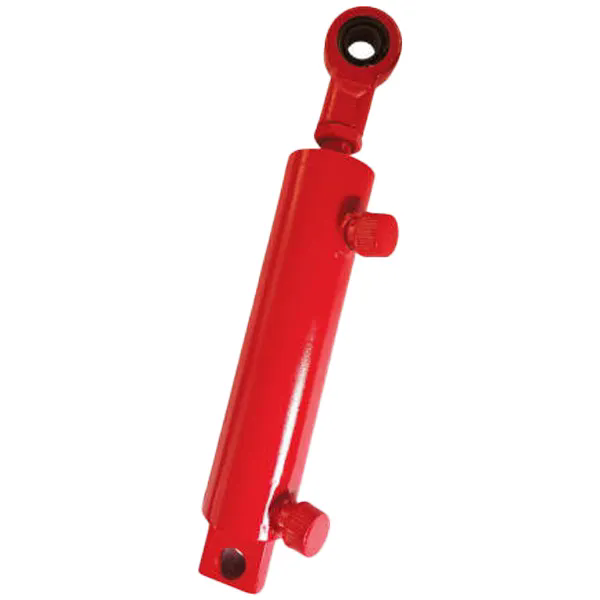
1. How Does Stroke Length Determine Header Lift Height and Clearance?
The most visible role of a Hydraulic Cylinder on a harvester is the header lift. The stroke length directly determines how far the header can rise above the ground and how far it can lower. A stroke that is too short means the header cannot lift high enough for transport, causing damage to the header or the road surface. A stroke that is too long means the cylinder may bottom out in the full extension, causing internal damage to the piston. In our factory, we have measured the stroke requirements for different harvester types. The table below shows the typical stroke lengths recommended for various header configurations.
| Harvester type | Header/implement | Typical stroke required (mm) | Common stroke that causes problems |
| Grain combine (Class 8) | Header lift (35 ft) | 500 – 600 | 450 (too short, hits ground during transport) |
| Sugar cane harvester | Base cutter lift | 300 – 400 | 250 (cannot clear field obstacles) |
| Forage harvester | Reel lift and positioning | 400 – 500 | 600 (excessive, cylinder binds at full extend) |
| Cotton picker | Spindle drum lift | 350 – 450 | 300 (does not clear rows for turning) |
The stroke length is not the only factor. The cylinder mounting geometry also affects the stroke length calculation. A simple cylinder with two pivot points has a stroke equal to the difference between the extended and retracted center-to-center distances. However, if the cylinder is mounted at an angle, the actual stroke requirement increases. Our factory recommends that designers use a kinematic simulation to determine the required stroke before finalizing the cylinder specification. At Raydafon Technology Group Co.,Limited, we provide a cylinder design worksheet that includes a stroke calculation tool for common harvester mechanisms.
2. What Is the Relationship Between Stroke and Buckling Resistance?
As the stroke length increases, the extended rod length increases. A longer rod is more susceptible to buckling, especially when side loads are present. Buckling occurs when the rod bends under compression, which can cause seal damage, scoring, and eventual rod breakage. The maximum allowable stroke for a given rod diameter is determined by the Euler buckling formula. In our factory, we use a safety factor of 3.0 for agricultural cylinders. The table below shows the maximum recommended stroke for different rod diameters at a given operating pressure.
| Rod diameter (mm) | Maximum safe stroke (mm) at 180 bar | Maximum safe stroke (mm) at 210 bar | Remarks |
| 25 | 450 | 400 | Suitable for light duty (reel, chute) |
| 35 | 650 | 580 | Suitable for medium duty (header lift, medium combines) |
| 45 | 900 | 800 | Suitable for heavy duty (large combines, sugarcane base cutters) |
| 55 | 1,200 | 1,050 | Suitable for extra heavy (steering cylinders, large loaders) |
When a Hydraulic Cylinder with a stroke longer than the recommended maximum is used, the risk of rod buckling increases significantly. In our factory, we have seen field failures where a cylinder with a 750 mm stroke and a 35 mm rod was used on a combine header. The rod bent on the first day of harvest, causing a 4-hour downtime and a $1,800 repair. The correct specification was a 45 mm rod with a 600 mm stroke. The lesson is that stroke and rod diameter must be matched to the operating pressure and the mounting configuration.
3. How Does Stroke Affect the Cylinder's Mounting Space and Layout?
The retracted length of a Hydraulic Cylinder is determined by the stroke plus the cylinder body length. In a harvester, space is often limited, especially in tight areas like the header frame or the folding mechanism. A longer stroke means a longer retracted length, which may not fit in the available space. In our factory, we have encountered designs where the stroke was increased by only 50 mm, but the retracted length exceeded the available space, requiring a complete redesign of the mounting bracket. The table below shows the space implications for different stroke lengths for a cylinder with a 100 mm body length.
| Stroke (mm) | Retracted length (mm) | Extended length (mm) | Space required for mounting (mm) |
| 200 | 300 | 500 | 420 |
| 300 | 400 | 700 | 520 |
| 400 | 500 | 900 | 620 |
| 500 | 600 | 1,100 | 720 |
The space constraint is particularly important in folding mechanisms for forage harvesters and large combines. A folding header must fit within the width of the machine during transport. A Hydraulic Cylinder with a longer stroke may be required to tuck the header in tightly, but the longer retracted length may interfere with other components. In our factory, we recommend that designers consider the space constraints before finalizing the stroke. We also offer custom stroke lengths in 5 mm increments to fit tight spaces.
4. How Does Stroke Selection Affect Hydraulic Oil Volume and Pump Capacity?
A longer stroke Hydraulic Cylinder requires more oil volume to extend and retract. The oil volume is calculated as the piston area multiplied by the stroke. For a cylinder with a 63 mm piston, a 400 mm stroke requires 1.25 liters of oil. A 600 mm stroke requires 1.87 liters. The difference is 0.62 liters per full cycle. In a harvester with multiple Hydraulic Cylinder units working simultaneously (header lift, steering, reel positioning), the total oil volume requirement increases significantly. This may require a larger pump or a larger reservoir, which adds weight and cost. In our factory, we have worked with OEMs who reduced the stroke of a steering cylinder from 400 mm to 350 mm to reduce the oil volume requirement, allowing them to use a smaller pump and save $200 per machine.
Frequently Asked Questions About Hydraulic Cylinder Stroke in Harvesters
Summary for Agricultural Equipment Designers and Farm Maintenance Teams
The stroke of a Hydraulic Cylinder is a fundamental design parameter that affects header lift height, buckling resistance, mounting space, and oil volume requirements. A stroke that is too short limits functionality. A stroke that is too long creates risks of buckling, space problems, and higher oil requirements. The correct stroke is determined by the mechanism geometry, the operating pressure, and the space constraints. Our factory has supplied Hydraulic Cylinder units to harvester OEMs and aftermarket repair shops for over 20 years. We provide stroke calculation assistance, rod diameter recommendations, and mounting layout verification.
Raydafon Technology Group Co.,Limited manufactures Hydraulic Cylinder units with standard and custom stroke lengths. Our cylinders are tested for buckling resistance, seal integrity, and stroke accuracy. We provide a cylinder specification sheet with every unit, including the retracted and extended lengths, piston area, and oil volume per stroke.