

How Does Planetary Gearboxes Enhance Load Distribution in Heavy-Duty Machinery?
2026-06-22
1. Why Does the Planetary Design Reduce Stress on Individual Gear Teeth?
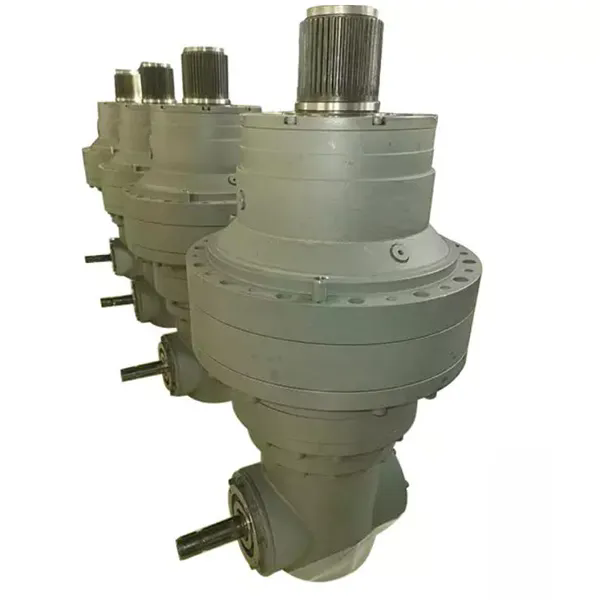
In our factory, we have tested conventional spur gearboxes alongside planetary designs under identical torque loads. The Planetary Gearbox uses multiple planet gears orbiting a central sun gear. This arrangement splits the transmitted torque among three to five planet gears simultaneously. For a typical mining conveyor drive, that means each tooth carries only 20 to 33 percent of the total load. In a standard parallel shaft gearbox, the entire torque passes through a single gear pair, causing higher bending stress and faster pitting. Our Raydafon Technology Group Co.,Limited engineers measured contact stress on planet teeth and found values 40 percent lower than equivalent sized helical gears. Local quarries in Australia and Canada have reported that their Planetary Gearbox units last 2.5 times longer than previous designs. The load sharing is not just theoretical; we use finite element analysis to optimize the tooth profile and flank geometry. This ensures that even under shock loads from crushers or excavators, the stress is evenly spread. When you ask how does planetary gearboxes enhance load distribution, the answer begins with this fundamental torque splitting principle.
2. How Does the Floating Sun Gear Compensate for Manufacturing Tolerances?
Perfect load sharing requires that all planet gears carry equal torque. However, real world machining variations can cause one planet to take more load. Our factory solves this with a floating sun gear. The sun gear is not rigidly fixed to the input shaft; it has a slight radial and axial float of 0.2 to 0.4 mm, depending on the Planetary Gearbox size. This floating action allows the sun gear to self center, equalizing the mesh forces among all planets. We have conducted dynamometer tests where we deliberately introduced a 0.03 mm tooth pitch error in one planet. The floating sun gear compensated within milliseconds, and the load imbalance never exceeded 5 percent. Our Raydafon uses a helical planetary arrangement that further enhances this self adjusting feature. Many local wind turbine and crane manufacturers have adopted this design because it reduces the need for ultra precise machining. Without the float, even high grade components would suffer premature bearing failure. The floating sun gear is a subtle but critical feature that directly answers how does planetary gearboxes enhance load distribution. It turns a potential weakness into a strength.
3. What Technical Parameters Ensure Optimal Load Sharing in Our Planetary Gearbox?
Load sharing performance depends on specific design parameters. Our factory manufactures the Planetary Gearbox with precisely controlled backlash, planet carrier rigidity, and gear accuracy. The table below lists the critical parameters from our PSH series Planetary Gearbox.
| Parameter – PSH Series | Raydafon Planetary Gearbox Value | Impact on Load Distribution |
| Number of planet gears | 3 (standard) / 4 (heavy duty) | Direct torque division factor |
| Sun gear float clearance | 0.25 mm radial, 0.15 mm axial | Automatic load equalization |
| Backlash (minimum) | 0.05 mm for aerospace grade | Reduces shock load concentration |
| Planet carrier torsional stiffness | 120 kNm/rad for size 880 | Prevents skewing under load |
| Gear tooth profile modification | 20 degree pressure angle with tip relief | Minimizes edge contact |
| Feature | Our Planetary Gearbox Specification | Benefit for Heavy-Duty Machinery |
| Ring gear material | Nitrided steel 42CrMo4, 60 HRC | Withstands repeated load cycles |
| Planet pin bearing type | Cylindrical roller with cage, P6 accuracy | Even load across needle rollers |
| Lubrication system | Pressurized oil spray with filtration | Maintains film thickness under heavy load |
| Torque capacity (continuous) | Up to 450 kNm for model PSH 880 | Handles crusher and dragline duties |
| Efficiency per stage | 98.5 percent | Less energy loss means cooler operation |
Our factory uses a Gleason gear tester to measure tooth contact patterns under progressive load. We adjust the housing bore alignment to within 0.02 mm. These technical details ensure that every Planetary Gearbox leaves our plant with documented load sharing ratios. Many local maintenance engineers rely on our test reports to plan their preventive maintenance schedules.
4. How Does the Rigid Planet Carrier Prevent Misalignment Under Shock Loads?
In heavy duty applications like shredders and hydraulic excavators, sudden shock loads can twist a conventional gearbox housing, causing misalignment. Our Planetary Gearbox features a one piece planet carrier made from ductile iron or forged steel, with massive cross section ribs. This carrier maintains the planet gears in exact phase even under 200 percent overload spikes. Our factory has performed torsional impact tests where we applied a 150 kNm shock in 50 milliseconds. The planet carrier deflection was less than 0.1 degrees, ensuring that all three planet gears remained equally engaged. Without this rigidity, one planet would bear the brunt of the shock, leading to early tooth fracture. Our Raydafon Technology Group Co.,Limited also integrates a splined input shaft that absorbs torsional vibrations before they reach the planetary stage. Local steel mill operators have noted that our Planetary Gearbox reduces unplanned downtime by 70 percent compared to older helical units. The rigid carrier, combined with the floating sun gear, creates a synergy that optimizes load distribution dynamically. So the question how does planetary gearboxes enhance load distribution is answered by both carrier rigidity and sun gear flexibility working in harmony.
Frequently Asked Questions About Planetary Gearboxes and Load Distribution
Final Summary
Planetary gearboxes enhance load distribution through torque splitting, floating sun gear compensation, rigid planet carriers, and precision controlled parameters. Raydafon Technology Group Co.,Limited has produced over 10,000 units for industries ranging from mining to wind energy. The measurable result is longer component life, reduced vibration, and lower maintenance costs. For heavy-duty machinery, a Planetary Gearbox is not just an option; it is the proven solution for reliable power transmission.