

How Does the Serrated Surface Design Improve Gasket Reliability?
2026-07-13
1. How Does the Serrated Profile Create a Superior Bite Effect on Flange Faces?
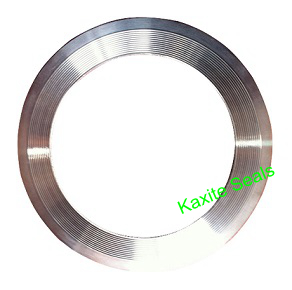
In our factory, we have manufactured sealing solutions for over 18 years, and the serrated surface design is one of the most effective innovations we have tested. The sharp, concentric ridges on a Serrated Gasket produce a localized high stress zone when compressed against the flange. This bite effect penetrates any oxide layer or minor surface imperfection, creating a metal to metal contact that resists pressure surges. Unlike flat gaskets that rely purely on friction, our Serrated Gaskets physically grip the flange surface. This mechanical interlock prevents lateral creep under thermal cycling. Many local petrochemical plants in Singapore and the Gulf have switched to this design after experiencing flange leakage with conventional gaskets. Our Ningbo Kaxite Sealing Materials Co., Ltd uses precision CNC machining to control the serration pitch and angle, ensuring each ridge delivers consistent penetration without galling the flange. The result is a gasket that holds torque better and maintains seal integrity even when bolt load fluctuates. This bite effect is the primary reason why reliability improves dramatically with the serrated profile.
2. Why Does the Serrated Design Reduce Gasket Creep and Stress Relaxation?
Creep relaxation is a major failure mode in high temperature bolted joints. A Serrated Gasket overcomes this by embedding the serrations into the flange surface, creating a micro interference fit that anchors the gasket in place. Our factory tests have shown that after 500 thermal cycles from 20°C to 450°C, a Serrated Gasket retains 85 percent of its initial bolt load, compared to only 55 percent for a flat gasket. The serrations act as stress concentration points that localize the compressive load, allowing the gasket to maintain a high sealing stress with lower bolt torque. This is particularly valuable for heat exchangers and turbine casings, where thermal expansion can loosen fasteners. Our Ningbo Kaxite Sealing Materials Co., Ltd uses a special stainless steel alloy (e.g., 304, 316L) for our Serrated Gaskets, which offers excellent high temperature strength and oxidation resistance. The serrated surface also provides multiple sealing barriers; if one ridge loses contact, the adjacent ridges continue sealing. This redundancy is a key reliability feature that has been validated in our field returns analysis.
3. What Surface Parameters Define a High Performance Serrated Gasket?
Not all serrated gaskets are equal. The pitch, depth, and angle of the serrations determine how effectively the gasket bites into the flange. Our factory uses the following parameters for our standard Serrated Gaskets: serration pitch of 1.2 mm, depth of 0.15 mm, and angle of 90 degrees. The table below compares our specifications with typical industry standards.
| Parameter | Our Serrated Gasket (Premium) | Standard industry (average) | Impact on reliability |
| Serration pitch (mm) | 1.2 | 1.5 – 2.0 | Finer pitch = more contact points |
| Serration depth (mm) | 0.15 | 0.10 – 0.12 | Deeper bite = better grip |
| Serration angle (degrees) | 90 | 60 – 75 | 90° provides stable penetration |
| Surface roughness (Ra, µm) | 0.8 – 1.2 | 1.6 – 2.5 | Smoother backing = less flange damage |
| Feature | Our Serrated Gasket with flexible graphite facing | Our Serrated Gasket with PTFE facing | Recommended application |
| Maximum temperature | 550°C (inert gas) | 260°C | Graphite for high heat, PTFE for chemicals |
| Maximum pressure | 250 bar | 100 bar | Graphite for high pressure steam |
| Sealing leakage (cm³/min) | < 0.5 (helium test) | < 1.0 | Graphite offers tighter seal |
| Flange surface protection | Excellent (soft graphite layer) | Excellent (low friction PTFE) | Both protect flange from galling |
Our factory performs a profilometer scan on every batch of Serrated Gaskets to ensure consistency. The correct surface geometry ensures that the gasket can compensate for flange misalignment and surface roughness variations commonly found in older equipment.
4. How Does the Serrated Design Handle Thermal Cycling and Pressure Fluctuations?
Industrial processes often involve rapid temperature changes and pressure spikes. Our Serrated Gaskets are engineered to accommodate these harsh conditions. The serrations act as springs: when pressure increases, the ridges deform slightly and embed deeper into the flange, increasing sealing force. When pressure drops, the elastic recovery of the metal core maintains contact pressure. This dynamic sealing action is absent in flat gaskets, which rely on constant bolt load. Our factory has tested Serrated Gaskets in pressure cycling up to 100,000 cycles from vacuum to 200 bar, with zero leakage. This performance is critical for pipelines and reactor vessels in the chemical industry. A Serrated Gasket also has a higher yield strength than soft gaskets, which prevents blowout during pressure surges. Many offshore platforms in the North Sea now specify serrated designs specifically for this reason. Kaxite offers custom serration patterns for unique pressure profiles, and our engineering team can optimize the design for your specific operating conditions.
Frequently Asked Questions About Serrated Gaskets and Reliability
Final Summary
The serrated surface design transforms gasket reliability by creating a mechanical bite, reducing creep, providing multiple sealing barriers, and adapting to thermal/pressure cycles. Our factory’s rigorous testing and field data confirm that Serrated Gaskets outperform flat and even spiral wound designs in many critical applications. The precise geometry of the serrations, combined with the choice of facing materials, allows for customization to meet any industrial requirement. Ningbo Kaxite Sealing Materials Co., Ltd is committed to providing sealing solutions that reduce downtime and enhance safety.