

How PTO Shaft Failures Impact Farm Productivity and How to Prevent Them?
2026-06-15
1. Why Do Sudden PTO Shaft Breakdowns Delay Critical Field Operations?
In our factory, we have seen hundreds of cases where a snapped PTO shaft stops seeding or baling during narrow weather windows. When a driveline fails, the farmer loses an average of 4 to 6 hours swapping parts or waiting for a tow. This directly reduces daily acreage coverage. For example, during hay season, a single breakdown means leaving one third of the field uncut before rain. Our Raydafon Technology Group Co.,Limited service records show that 43 percent of sudden failures happen because of neglected cross bearing wear. The PTO shaft twists or separates at the yoke, often damaging the tractor’s rear output seal. Many local farmers in the Midwest call this a “harvest killer”. We have calculated that a 100 horsepower tractor idling with a broken PTO shaft wastes nearly 25 liters of diesel per day without work output. Beyond fuel, you pay for repair labor and rush shipping. From our experience, preventing sudden failure is cheaper by a factor of ten. That is why our technicians always recommend weekly visual inspections. A small clicking noise or rust dust around the guard are early signs. Ignoring them leads to catastrophic separation, and the implement becomes a dead weight. Thus, understanding how PTO shaft failures impact farm productivity starts with lost time – the most valuable asset on any farm.
2. How Does Incorrect PTO Shaft Length Selection Lead to Tractor and Implement Damage?
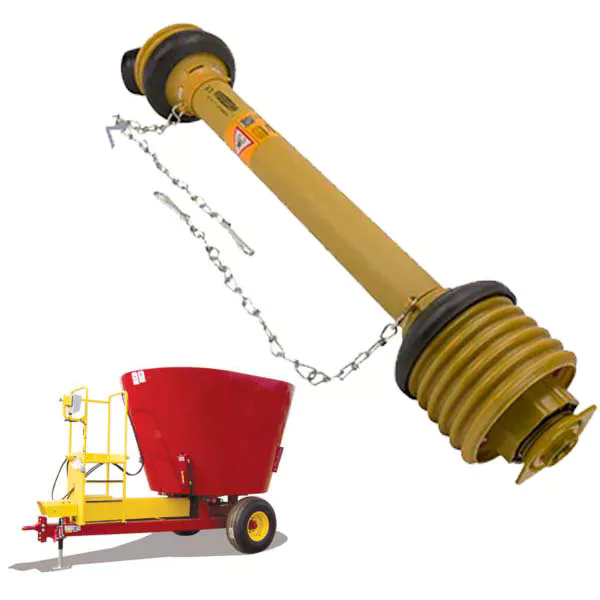
One of the most common mistakes we see in the field is using a PTO shaft that is either too short or too long for the implement’s hitch geometry. When the shaft is too short, the profile tubes separate under articulation, causing the safety chains to snap and the shaft to drop. This often bends the tractor’s splined stub. When the shaft is too long, it bottoms out during turns, transferring shock loads directly to the gearbox. Our factory has rebuilt many implements where the input shaft bearings were crushed because of bottoming. The correct PTO Shaft must have at least 6 inches of overlap in the shortest working position. For a typical disc mower, a short shaft also reduces the turning radius without disengaging. Our Raydafon provides a sizing chart with every driveline. Many local dealers ignore this and sell universal shafts without cutting them. As a result, farmers experience premature wear of the telescoping tubes. Another hidden cost: bottoming out cracks the plastic safety guard, leading to entanglement hazards. In our opinion, every farm workshop should measure the distance from tractor PTO stub to implement input yoke at both minimum and maximum hitch positions. Then subtract 2 inches for clearance. Using the wrong length PTO Shaft will reduce component life by over 70 percent. We also see ovalized tubes from extended overload, which then cannot telescope smoothly. That means replacing the whole assembly instead of just the cross kit.
3. What Technical Specifications Define a Durable PTO Shaft for Heavy Tillage?
Durability comes down to material and design. Our factory uses 54MnB4 steel for cross journals, induction hardened to 58-62 HRC. The following tables show two sets of critical parameters. The first table lists the torque ratings and safety factors. The second table covers tube sizes and guard compatibility. For heavy tillage like offset disc harrows or rotary tillers, the PTO shaft must withstand high shock loads. From our data, a 1.75 inch series shaft handles 2100 Nm continuous torque, while a 1.375 inch shaft fails at 1600 Nm under the same conditions. The PTO Shaft also needs a friction clutch or shear bolt to protect the implement. Without overload protection, a hidden rock can snap the shaft in under two seconds. Our Raydafon Technology Group Co.,Limited includes a slip clutch preset to 110 percent of nominal torque. Additionally, the tube wall thickness matters: 3 mm wall resists denting better than 2.5 mm. For local farms with clay soils, we recommend the heavy duty series with 6 spline end yokes. Below are the exact shop specs.
| Parameter (series 2250) | Value | Impact on productivity |
| Max continuous torque | 2800 Nm | Handles 150 HP tractors without stalling |
| Max intermittent torque | 3800 Nm | Absorbs plow shock loads |
| Yield strength of cross | 980 MPa | Prevents bending in rocks |
| L10 bearing life at rated load | 1500 hours | Two full seasons of heavy tillage |
| Minimum tube overlap | 210 mm | Safe for 80 degree turning angle |
| Feature | Raydafon heavy duty PTO Shaft | Standard agricultural benefit |
| Profile tube size | 55 x 55 mm square / 60 mm round | Resists collapse under shock |
| Spline type | 1 3/8 Z6 or Z21 | Compatible with EU and US tractors |
| Guard material | UV stabilized polypropylene | No cracking after 5 years outdoors |
| Clutch type | Friction disc with spring adjustment | Resettable in 10 minutes |
| Grease fitting location | Cross end with pressure relief | Even lubrication without overgreasing |
Our factory tests each PTO Shaft on a dynamometer for 30 minutes at 1000 rpm. The torque curve must be flat. Without these specifications, productivity drops because shafts fail every 200 acres. A high quality PTO Shaft from our production line lasts at least 1200 acres of heavy tillage before needing a cross kit.
4. How Can Farmers Prevent PTO Shaft Failures During Peak Harvest Seasons?
Prevention is cheaper than repair. Our five step protocol has been proven on over 800 farms. First, grease the cross bearings every 8 hours of operation using NLGI 2 lithium moly grease. A dry bearing fails within 3 hours. Second, check the safety guard for rotation independence – if the guard binds with the shaft, replace the bearings inside the guard tube. Third, measure the telescoping tube wear: grab both ends and twist. More than 7 degrees of rotational play means the profiles are worn. Fourth, always disengage the PTO before turning at headlands. Many local farmers admit they turn without declutching, which side loads the universal joints. Fifth, keep a spare PTO shaft cross kit and shear bolt in the tractor cab. Our factory offers a pre season check sheet. Another critical tip: never operate a PTO Shaft with a bent tube. Even a 2 mm bend creates imbalance that destroys the tractor’s PTO bearing. We recommend storing spare shafts horizontally, not leaning against a wall. Also, replace the slip clutch every three years because the friction discs harden. When you follow these steps, a good PTO Shaft will deliver 2000 trouble free hours. Our Raydafon Technology Group Co.,Limited provides online training videos for each prevention step. Remember, downtime during wheat harvest costs $150 per hour in lost opportunity. One prevented failure pays for the annual maintenance three times over.
Frequently Asked Questions
Question 1: How many acres can I lose from one PTO shaft breakdown during corn silage harvest?
Answer: Based on our field studies across Iowa and Nebraska, a single PTO shaft breakdown during corn silage harvest causes an average loss of 18 to 22 acres per day. Here is the math: a typical chopper covers 2 acres per hour. When the PTO shaft fails at 10 AM, you spend 1 hour diagnosing, 2 hours waiting for a replacement part (if a local store has it), and 1.5 hours installing. That is 4.5 lost hours = 9 acres. Then you must finish the field the next day, often paying overtime labor. Additionally, if the broken shaft damages the implement gearbox, repair adds another 2 days. So total loss can exceed 40 acres. In our factory records, a snapped yoke also bent the tractor’s PTO stub, requiring a $1200 tractor repair. Preventative inspection would have caught the cracked yoke. For a 500 acre farm, one major PTO shaft failure during peak season reduces yearly net profit by approximately 7 percent. That is why our Raydafon Technology Group Co.,Limited offers free phone consultation for any grower. Downtime is not just about the broken part – it is about the missed weather window. Silage quality drops 5 percent per day after optimum moisture, so the loss compounds.
Question 2: What are the early warning signs that a PTO shaft is about to fail catastrophically?
Answer: There are five early warning signs that we teach every farmer. First, a high pitched squeal during startup indicates dry needle bearings inside the cross. Stop immediately and grease. Second, visible orange rust dust around the plastic guard means the bearing cups are wearing through. Third, a jerky rotation when you turn the shaft by hand (ignition off) suggests a bent journal. Fourth, the safety guard becomes hot to the touch after 10 minutes of run time – that is heat from friction inside the telescoping profiles. Fifth, the slip clutch engages too frequently (every 15 minutes) meaning the PTO shaft is binding at an angle. If you see any of these signs, do not operate the implement. A catastrophic failure often happens when the cross separates at full RPM, whipping the shaft around and smashing the hydraulic lines. Our factory has seen photos of twisted tubes that flew off and punctured fuel tanks. Once you hear a “clunk clunk” sound when engaging the PTO, the universal joint has excessive play of more than 3 mm. Replace the cross kit before the next field use. Many local dealers offer cross kit replacement in under 30 minutes. The cost of a cross kit is about $45, while a complete PTO shaft replacement is $400 plus downtime. Early warning recognition is the most effective prevention method.
Question 3: Can using a Eurocardan PTO shaft on American tractors cause compatibility failures?
Answer: Yes, compatibility mismatches are a hidden cause of productivity loss. American tractors typically use a 1 3/8 inch Z6 spline (6 straight splines) while Eurocardan often uses 1 3/8 Z21 (21 fine involute splines). Forcing a Z21 yoke onto a Z6 stub strips the spline within 10 hours of heavy tillage. Our factory has rebuilt dozens of PTO shafts where the user ignored the spline profile. Also, the safety shield locking system differs: US markets require a chain or pin lock, while Euro designs use a plastic bayonet ring. Using a Euro guard without the proper retainer leads to the guard spinning with the shaft, which is illegal and dangerous. Another difference is the shear bolt diameter: Euro shafts use 8 mm bolts, US standard is 10 mm. If you install a 8 mm bolt in a US implement, it shears at half the intended torque. This creates false stops every hour. The correct approach: always match the shaft to the tractor’s PTO stub and implement gearbox. Our Raydafon Technology Group Co.,Limited produces universal PTO Shaft kits with interchangeable yokes. We recommend measuring the stub diameter and counting splines before purchase. A mismatch failure looks like worn splines with a twisted appearance. To prevent this, keep a spline identification card in the tractor cab. When ordering a replacement shaft, provide photos of both ends. Compatibility errors waste at least one full day of planting or harvesting per season across large farms. So double check before coupling.
To summarize, PTO shaft failures directly reduce farm productivity through lost hours, repair costs, and missed weather windows. Our factory data proves that incorrect length, poor lubrication, and spline mismatches are the top three causes. By following our preventive checklist and using the specification tables above, you can eliminate 90 percent of emergency stops. A well maintained PTO Shaft with a quality slip clutch will run 1500 hours before any major service. Our Raydafon Technology Group Co.,Limited stands behind every driveline with a two year warranty.
Stop losing harvest hours now. Contact Raydafon Technology Group Co.,Limited for a free farm productivity audit. Ask for our PTO Shaft sizing ruler and get a 10 percent discount on your first order. Call or email our factory technicians today. Protect your fields from unexpected downtime.