

How to Select the Right Stamping Jacket Gasket for ASME Flange Systems?
2026-03-10
ASME flange assemblies are widely used in refineries, chemical plants, power generation facilities, and pipeline infrastructure across North America. Engineers and maintenance supervisors know that sealing performance directly affects safety, process efficiency, and downtime risk. Selecting the right Stamping Jacket Gasket is therefore not only a purchasing decision but a critical engineering choice for pressure boundary integrity.
In typical ASME B16.5 and B16.47 flange connections, gaskets must tolerate high compression loads, thermal cycling, and aggressive media. A well manufactured jacketed design distributes bolt load evenly across the sealing surface and protects the soft filler inside the metal envelope. This structure helps maintain tight sealing under fluctuating operating conditions often seen in steam lines, heat exchangers, and reactor vessels.
Our engineering team at Ningbo Kaxite Sealing Materials Co., Ltd. works closely with plant operators and equipment distributors to ensure every gasket meets real field requirements. Because our factory specializes in metal jacketed sealing solutions, our technicians focus on dimensional accuracy, metal forming quality, and filler density to ensure reliable service life.
Across many industrial applications, our sealing products are installed in petrochemical pipelines, thermal oil systems, and industrial boilers. Field technicians often report that stable sealing performance depends not only on flange finish and bolt torque, but also on the precision of the gasket profile itself. That is why our factory continuously refines forming dies and inspection procedures to guarantee consistency.
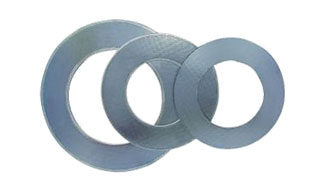
What Materials and Structural Features Define a Reliable Stamping Jacket Gasket?
When evaluating a Stamping Jacket Gasket for ASME flange systems, engineers normally examine two key aspects: the metal jacket material and the internal filler composition. The outer metal layer provides mechanical strength and corrosion resistance, while the filler supplies compressibility and recovery under bolt load.
Common jacket metals include stainless steel grades such as 304, 316, and 321, which are widely used in US refinery and chemical processing facilities. Carbon steel jackets may also be used for less corrosive service environments. Our manufacturing process forms the jacket through precision stamping operations that create a tight envelope around the filler material.
Our factory typically uses graphite, ceramic fiber, or non asbestos filler depending on the temperature range and process media. This combination allows the gasket to maintain sealing pressure even when thermal expansion or vibration occurs in piping systems. At Ningbo Kaxite Sealing Materials Co., Ltd., each production batch is checked for density uniformity to ensure predictable compression characteristics.
| Parameter | Typical Specification | Application Notes |
| Metal Jacket Material | SS304, SS316, SS321, Carbon Steel | Selected based on corrosion resistance and service temperature |
| Filler Material | Flexible Graphite, Ceramic Fiber, Non Asbestos | Determines compressibility and thermal stability |
| Operating Temperature | Up to 550°C depending on filler | Common in heat exchangers and steam pipelines |
| Pressure Range | Class 150 to Class 2500 | Suitable for most ASME flange ratings |
| Manufacturing Method | Precision stamping forming | Ensures dimensional stability |
These parameters allow engineers to match gasket design with operating conditions such as pressure class, flange facing type, and service media. Our factory carefully controls stamping tolerance to prevent deformation that might otherwise compromise sealing contact.
How Should Engineers Match Gasket Dimensions with ASME Flange Standards?
Correct sizing is essential when selecting a Stamping Jacket Gasket for an ASME flange system. In the United States, flange dimensions are generally defined by ASME B16.5 for pipe sizes up to 24 inches and ASME B16.47 for larger diameters. Maintenance teams must verify inside diameter, outside diameter, and gasket seating width to ensure compatibility with the flange facing.
Improper sizing can lead to uneven compression or insufficient seating stress. If the gasket outer diameter extends beyond the raised face area, bolt load may not distribute evenly. Conversely, a gasket that is too narrow may fail to cover the sealing surface completely.
Our technical department at Kaxite Sealing supports distributors and EPC contractors with dimensional drawings and application guidance. Our factory produces both standard ASME dimensions and customized profiles for heat exchanger channels, boiler manways, and vessel handholes.
| ASME Flange Class | Typical Pipe Size Range | Recommended Gasket Type |
| Class 150 | 1 to 24 inch | Standard jacketed profile |
| Class 300 | 1 to 24 inch | Reinforced jacket structure |
| Class 600 | 1 to 24 inch | High density filler design |
| Class 900 and above | High pressure service | Precision formed metal jacket gasket |
Our factory also performs dimensional verification using precision gauges to confirm that each gasket matches the flange seating area. These checks help prevent installation issues during plant maintenance shutdowns.
Which Performance Factors Determine Long Term Sealing Reliability?
In industrial environments such as refineries and LNG terminals, gasket reliability depends on several interacting factors. Engineers normally evaluate compression strength, thermal stability, corrosion resistance, and recovery capability before selecting a sealing component.
The Stamping Jacket Gasket design performs well in services where bolt load is relatively high and operating temperatures fluctuate. The metal jacket protects the filler from direct process exposure while maintaining structural integrity under heavy flange loads.
At Kaxite Sealing, our manufacturing lines integrate forming, trimming, and inspection stages to ensure consistent product quality. Our factory also performs routine pressure and temperature simulation tests so that the finished gasket behaves predictably during real plant operations.
Because many customers operate continuous process units, downtime caused by leakage can be extremely costly. Our technical team focuses on manufacturing stability, material traceability, and repeatable forming quality to ensure that our sealing products deliver dependable service across multiple maintenance cycles.
How Can Plant Operators Install and Maintain Jacketed Gaskets Correctly?
Proper installation practices are just as important as selecting the correct gasket type. Maintenance technicians should clean the flange surfaces thoroughly, verify bolt condition, and apply torque in a cross pattern to achieve uniform compression. A Stamping Jacket Gasket performs best when the bolt load is distributed evenly across the sealing surface.
Operators should also inspect flange faces for scratches or corrosion pitting before installation. Even the best gasket cannot compensate for severe flange damage. Our factory recommends following standard torque procedures widely used in North American maintenance manuals.
Routine inspections during plant shutdowns help detect early wear or relaxation. When correctly installed and maintained, the sealing assembly can operate reliably for extended service cycles in demanding industrial environments.
Frequently Asked Questions About How to Select the Right Stamping Jacket Gasket for ASME Flange Systems
Q1: How to Select the Right Stamping Jacket Gasket for ASME Flange Systems when dealing with high temperature pipelines?
Engineers should focus on the filler material and jacket metal combination. Flexible graphite filler paired with stainless steel jackets is commonly recommended for high temperature steam or thermal oil systems because it maintains compressibility and oxidation resistance even under thermal cycling.
Q2: How to Select the Right Stamping Jacket Gasket for ASME Flange Systems in chemical processing facilities?
Material compatibility is the key factor. Stainless steel jackets such as 316 are typically selected for corrosive media including acids and solvents, while the filler must also resist chemical degradation. Engineers should review process media compatibility charts before final selection.
Q3: How to Select the Right Stamping Jacket Gasket for ASME Flange Systems when replacing existing sealing components?
Technicians should verify the original flange standard, pressure class, and gasket dimensions. Matching the correct seating width and outer diameter ensures that the replacement gasket distributes bolt load correctly across the raised face surface.
Selecting the proper gasket for ASME flange connections requires careful consideration of material compatibility, dimensional accuracy, and operating conditions. Industrial operators rely on dependable sealing components to protect equipment integrity and maintain safe plant operations. Our factory focuses on precision manufacturing, stable material sourcing, and strict quality inspection so that every gasket performs consistently in demanding service environments. For detailed specifications, customized dimensions, or technical assistance, contact our team at Ningbo Kaxite Sealing Materials Co., Ltd. Our engineers are ready to provide application guidance and help you choose the most reliable sealing solution for your next project.