

How Vacuum Suction Cups Support High-Speed Packaging and Carton Handling Lines?
2026-09-02
In a high speed packaging line, the vacuum suction cup is the point of contact between the automation system and the product. It is also the most frequently overlooked component. A cup that fails to grip consistently will cause dropped cartons, jams, and line stoppages. The cost of a single jam at 80 cycles per minute can exceed $200 in lost production and rework time. This guide is written for line managers who need to understand how to select, size, and maintain vacuum suction cups for reliable performance at speed.
1. What Happens to Suction Cup Performance as Line Speed Increases?
At low speeds, almost any cup will work. At high speeds, the dynamics change. The cup has less time to form a seal, the acceleration forces are higher, and the risk of release during transfer increases. The critical parameter is the response time: the time from vacuum application to full gripping force. In our factory, we have tested Vacuum Pads Vacuum Suction Cups at speeds ranging from 30 to 120 cycles per minute.
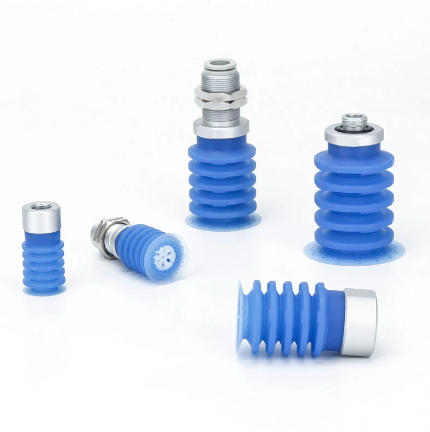
The table below shows the relationship between speed, cup diameter, and required vacuum pressure for a typical corrugated carton handling application.
| Line speed (cycles/min) | Recommended cup diameter (mm) | Minimum vacuum pressure (kPa) | Seal formation time (ms) | Key risk factor |
| 30 | 40 | 35 | 80 | Low |
| 60 | 50 | 45 | 50 | Carton sliding |
| 80 | 60 | 55 | 35 | Incomplete seal |
| 100 | 75 | 65 | 25 | Drop on release |
| 120 | 90 | 75 | 18 | Acceleration detachment |
At 100 cycles per minute, the cup has only 25 milliseconds to form a seal. This is less than the blink of an eye. The cup must have a flexible lip profile that conforms to the carton surface almost instantly. Our factory has developed a cup lip design that reduces seal formation time by 30 percent compared to standard designs. At Zhejiang Comma Electric Co., Ltd., we manufacture Vacuum Pads Vacuum Suction Cups with a specially formulated elastomer that maintains flexibility even in cold warehouse conditions, ensuring consistent seal formation.
2. Which Cup Material Works Best for Different Carton Surfaces?
The surface of a carton varies widely. Some are smooth, some are rough, some have a waxy coating, and some are printed with heavy ink. The cup material must match the surface characteristics. Nitrile (NBR) offers good oil resistance but can become hard in cold temperatures. Silicone handles high temperatures well but has lower tear resistance. Polyurethane (PU) provides excellent abrasion resistance and flexibility. The table below compares the performance of cup materials for different carton handling applications.
| Carton surface type | Recommended cup material | Primary advantage | Potential issue |
| Plain corrugated (dry) | Polyurethane (PU) | High grip, long wear life | Not suitable for oily surfaces |
| Wax coated (wet strength) | Silicone | High temperature resistance | Lower grip on smooth surfaces |
| Heavily inked / glossy | Nitrile (NBR) | Oil resistance, good grip | Hardens below 5°C |
| Dusty / recycled board | Natural rubber (NR) | Excellent initial grip | Short wear life in abrasive conditions |
| High speed (80+ cpm) | PU with optimized lip | Fast seal formation | Higher cost |
One of the most common mistakes is using a single cup type for all carton surfaces. In a typical packaging line, incoming cartons may come from different suppliers with different surface finishes. Our factory recommends selecting Vacuum Pads Vacuum Suction Cups based on the most challenging carton type, and then verifying performance across all carton variants. At Zhejiang Comma Electric Co., Ltd., we provide a cup selection service where we analyze your carton samples and recommend the optimal material and profile.
3. What Are the Real World Wear Factors That Affect Cup Life?
A suction cup is a consumable, but the replacement frequency varies dramatically based on operating conditions. The three main wear factors are abrasion from carton dust, degradation from ozone and UV exposure, and mechanical fatigue from the stroke cycle. In our factory, we have tracked cup life across 25 packaging lines. The table below shows the typical cup life under different operating conditions.
| Operating condition | Typical cup life (cycles) | Failure mode | Mitigation strategy |
| Clean cartons, indoor, low speed | 2,000,000+ | Lip wear | Inspect monthly |
| Dusty recycled board, medium speed | 800,000 – 1,200,000 | Abrasive lip wear | Install pre filter, inspect weekly |
| Wax coated cartons, high speed | 500,000 – 800,000 | Loss of flexibility | Use silicone, replace quarterly |
| Oily surfaces, high temperature | 300,000 – 500,000 | Chemical degradation | Use NBR, inspect weekly |
| Outdoor / UV exposure | 200,000 – 400,000 | Cracking | Use UV stabilized material |
The data shows that operating conditions can reduce cup life by a factor of 10. A line manager who understands these wear factors can plan replacement schedules that minimize unplanned downtime. In our factory, we recommend a simple inspection procedure: feel the lip flexibility and check for cracks every 500,000 cycles. At CommaElec, we provide a maintenance log template that includes cup inspection points.
4. How Does Cup Placement and Spacing Affect Pick Up Reliability?
Even the best cup will fail if it is placed incorrectly. The center of gravity of the carton, the position of the flaps, and the stiffness of the board all affect how the cup engages. The general rule is to place cups symmetrically around the center of gravity, with at least 80 percent of the cup surface in contact with a flat area of the carton. Avoid placing cups over seams or creases where the surface is uneven. In our factory, we use a simple test: place a cup on the carton and lift. If the carton bends significantly, the cups are too close to the edge or the vacuum pressure is insufficient. The correct setup will lift the carton with minimal deflection. We also recommend using a small cup diameter for light cartons and a larger diameter for heavy cartons. Our Vacuum Pads Vacuum Suction Cups are available in diameters from 20 mm to 150 mm, with custom profiles for specialized applications.
Frequently Asked Questions About Vacuum Suction Cups in Packaging Lines
Summary for Packaging Line Managers
Vacuum suction cups are a critical but often overlooked component in high speed packaging lines. The correct selection, placement, and maintenance of cups directly affects line reliability, product quality, and overall equipment effectiveness. By understanding the relationship between line speed, cup material, and wear factors, line managers can reduce unplanned downtime and extend cup life. Zhejiang Comma Electric Co., Ltd. manufactures Vacuum Pads Vacuum Suction Cups that are designed for demanding packaging applications. We provide technical support, material testing, and maintenance guidance to help you optimize your line performance.