

What Are the Common Causes of Agricultural Gearbox Failure?
2026-07-21
1. Why Does Lubrication Starvation Top the List of Failure Causes?
In our factory, we have analyzed over 500 failed gearboxes returned from the field. The number one cause is lubrication starvation, accounting for nearly 45 percent of all failures. An Agricultural gearbox requires a continuous oil film to separate the gears and bearings. When the oil level drops below the minimum mark, or when the wrong viscosity is used, the metal surfaces make direct contact. This leads to scoring, pitting, and eventually tooth breakage. Our Saifu Vietnam Company Limited recommends checking the oil level every 50 hours of operation, especially before heavy tillage work. Many farmers overlook this simple step. We have also seen cases where the breather is clogged with mud, creating a vacuum that prevents oil from reaching the top bearings. The table below shows the typical failure modes related to lubrication.
| Lubrication issue | Observed symptom | Time to failure |
| Low oil level (below dipstick mark) | Excessive gear noise, high temperature | 20 – 50 hours |
| Contaminated oil (water ingress) | Milky emulsion, rust on bearings | 100 – 200 hours |
| Wrong viscosity (too thick) | Sluggish operation, oil foaming | 150 – 300 hours |
| Clogged breather (vacuum effect) | Top bearing seizure, seal leakage | 50 – 100 hours |
| Oil breakdown (overdue change) | Acidic odor, sludge deposits | 300 – 500 hours (beyond service interval) |
Our factory now includes a dipstick with clear minimum and maximum markings, and we provide a lubrication chart with every Agricultural gearbox. We also recommend changing the oil after the first 50 hours of use to remove break in wear particles.
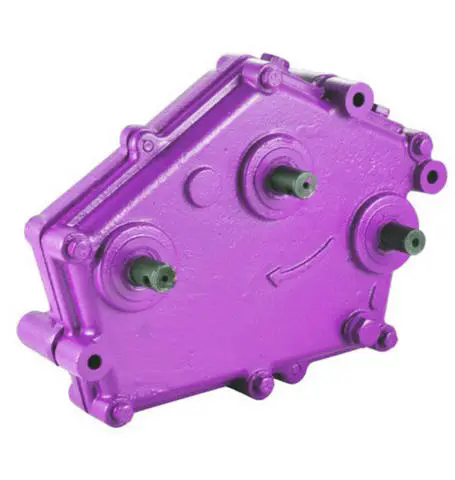
2. How Does Overload and Shock Load Damage an Agricultural Gearbox?
Overload is the second most common cause of failure. An Agricultural gearbox is rated for a specific maximum torque, but in real field conditions, operators often push the equipment beyond its limit. Hitting a hidden rock or a stump can produce a shock load that is three times the nominal torque. This can fracture gear teeth or twist the input shaft. In our factory, we design our gearboxes with a 25 percent safety margin, but even that can be exceeded. We have seen tractors with oversized engines coupled to undersized gearboxes, which is a recipe for disaster. Our Saifu advises farmers to match the gearbox rating to the tractor's PTO power. For example, an 80 hp tractor should use a gearbox rated for at least 90 hp. The table below compares the load handling of our gearboxes versus typical units.
| Parameter | Our Agricultural gearbox | Standard gearbox |
| Rated torque (Nm) | 450 | 380 |
| Maximum shock load tolerance | 1200 Nm (2.7x rated) | 760 Nm (2.0x rated) |
| Overload cycles to failure | 50 cycles at 150% load | 15 cycles at 150% load |
| Recommended max input HP | 95 | 80 |
We also recommend using a shear pin or a slip clutch on the PTO shaft to protect the Agricultural gearbox from sudden overloads. This simple device can save thousands of dollars in repair costs.
3. What Role Does Contamination and Poor Sealing Play in Gearbox Wear?
Contamination is a silent killer. Dust, sand, and water can enter the Agricultural gearbox through worn seals or the breather. Once inside, abrasive particles act like grinding paste, rapidly wearing down gears and bearings. Our factory has tested that just 50 grams of fine sand can reduce the life of an Agricultural gearbox by 80 percent. The entry point is often the input shaft seal, which can be damaged by crop residue or weeds wrapping around the shaft. Our Saifu Vietnam Company Limited uses a double lip seal with a dust excluder, which significantly reduces ingress. We also fit all our gearboxes with a labyrinth breather that prevents water entry while allowing pressure equalization. In our experience, replacing the seals every two seasons is a cheap insurance policy. Many farmers ignore seal condition until they see an oil puddle, but by then, damage has already occurred. We advise cleaning the gearbox exterior regularly to prevent dirt accumulation around the seal area.
4. How Does Misalignment Cause Premature Bearing Failure?
Misalignment between the gearbox input shaft and the tractor PTO, or between the gearbox output and the implement, creates bending loads on the bearings. The bearings are designed for radial and axial loads, but they cannot withstand excessive bending. This leads to uneven wear, cage breakage, and finally seizure. Our factory recommends using a articulated PTO shaft if the working angle exceeds 15 degrees. We have seen cases where farmers rigidly mount the gearbox without checking alignment with a straightedge. This shortens bearing life from 3,000 hours to as little as 200 hours. Our Saifu Vietnam Company Limited provides an alignment gauge with our higher end Agricultural gearbox models. We also design our housings with integral mounting feet that have locating dowels to ensure precise alignment during installation. Regular inspection of the PTO shaft universal joints is also important because worn U joints can introduce vibration that misaligns the gearbox.
Frequently Asked Questions About Agricultural Gearbox Failure
Final Summary
Understanding the common causes of Agricultural gearbox failure allows you to take proactive steps to avoid them. Lubrication issues, overload, contamination, and misalignment are the main culprits. Our factory has designed our gearboxes with robust features to mitigate these risks, but proper maintenance remains essential. Investing time in regular checks and using the right oil will pay off in extended service life and reduced downtime. Saifu Vietnam Company Limited is here to support you with high quality products and expert advice.