

What Are the Important Features of Professional Mould for Concrete Block Manufacturers?
2026-08-13
1. Why Does Steel Grade Determine the Lifespan of a Mould for Concrete Block?
In our factory, we have produced thousands of moulds for block plants worldwide. The steel grade is the foundation of a professional Mould for Concrete Block. We use high grade tool steel such as 40Cr or 55SiCr, with a carbon content of 0.4 to 0.6 percent. This provides a good balance of hardness and toughness. For high volume production, we recommend using moulds made from hardened steel with a surface hardness of 58 to 62 HRC. This hardness resists the abrasive wear from sand and aggregate. A softer mould may only last 100,000 cycles, while our hardened Mould for Concrete Block can exceed 500,000 cycles before needing refurbishment. Our Quangong Machinery Co., Ltd. also uses a nitriding treatment on the working surface, which increases wear resistance by 30 percent. Many local block manufacturers in Australia have reported that our moulds produce consistent blocks for over 4 years. The steel grade also affects the corrosion resistance; we add chromium and molybdenum to protect against the slightly alkaline concrete mix. The choice of steel is the first differentiator between a professional mould and a cheap imitation.
2. How Does Machining Precision Affect Block Quality and Demolding?
Precision is not a luxury; it is a necessity. A professional Mould for Concrete Block must have a dimensional tolerance of ±0.1 mm on all critical surfaces. Our factory uses 5 axis CNC machining centers to achieve this accuracy. The clearance between the mould core and the liner should be between 0.05 and 0.15 mm. If the clearance is too large, concrete paste will leak and cause flashing on the blocks. If it is too tight, the blocks will stick and be difficult to demold. This leads to broken edges and production delays. The surface finish of the cavity is also crucial. We grind the cavity to a roughness of Ra 0.8 µm, which allows the blocks to release cleanly. Our QGM uses coordinate measuring machines (CMM) to verify every dimension after machining. For a typical hollow block mould, we check 24 critical dimensions. Local block producers in the Philippines have told us that our moulds produce blocks with perfectly square edges, reducing the need for secondary grinding.
3. What Surface Treatments Extend the Service Life of a Concrete Block Mould?
Surface treatment is the secret to long mould life. Our factory applies a chromium nitride (CrN) coating to the cavity of every Mould for Concrete Block. This coating has a hardness of over 2000 HV and a low friction coefficient. It reduces the adhesion of cement paste and minimizes wear from the aggregates. We have tested coated versus uncoated moulds in parallel production. After 300,000 cycles, the uncoated mould showed significant wear at the corners, while the coated mould was still within tolerance. Another treatment we offer is tungsten carbide cladding on the high wear areas, such as the ejector pins and the edge chamfers. The table below summarizes the typical surface treatments we apply.
| Surface treatment | Hardness (HV) | Wear resistance improvement | Application area |
| CrN coating (PVD) | 2000 – 2200 | + 40% | Cavity and core surfaces |
| Nitriding (gas) | 900 – 1100 | + 25% | Mould base and guide pins |
| Tungsten carbide overlay | 1200 – 1400 | + 60% | High wear edges and ejector pins |
| Polishing (Ra 0.4 µm) | N/A | Reduces sticking | All cavity surfaces |
| Feature | Professional Mould (our standard) | Economy Mould |
| Steel hardness (HRC) | 58 – 62 | 45 – 50 |
| Surface coating | CrN or Nitriding | None or painted |
| Machining tolerance | ± 0.05 mm | ± 0.20 mm |
| Expected cycles before refurbishment | 500,000 | 100,000 |
| Block edge quality | Sharp, no burrs | Rounded, occasional flashing |
Our QGM also offers a re coating service when the mould returns for refurbishment. This restores the mould to near original performance.
4. How Does Mould Design Affect Concrete Compaction and Block Density?
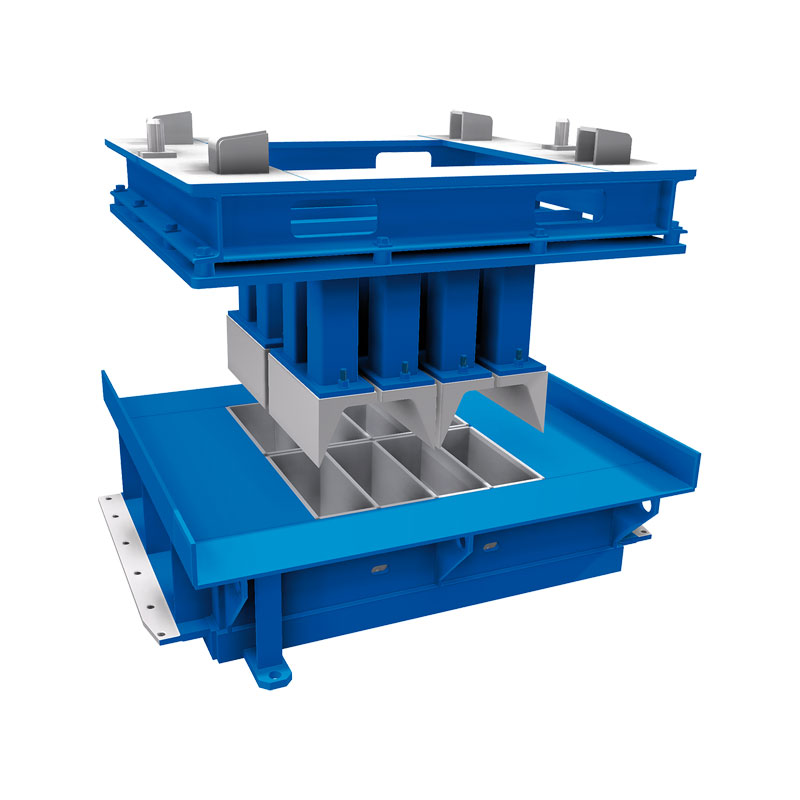
The geometry of the Mould for Concrete Block directly influences how the concrete flows and compacts. A professional mould has a draft angle of 0.5 to 1.0 degrees to facilitate demolding. The cavity shape is designed to minimize turbulence during filling. Our factory uses finite element analysis to optimize the flow of concrete into the corners. We also incorporate strategically placed vent holes to allow air to escape during vibration. Without proper venting, air pockets can form, leading to weak spots in the block. The depth of the cavity must match the desired block height with a precision of ±0.2 mm. Our moulds also have wear plates that can be replaced separately, extending the overall life. Many customers have noted that our moulds produce blocks with a more uniform density because the compaction is evenly distributed. This is particularly important for load bearing blocks that need to meet strict strength standards. Our design ensures that every block from the mould meets the required compression strength.
Frequently Asked Questions About Professional Concrete Block Moulds
Final Summary
A professional Mould for Concrete Block is characterized by high grade steel, precise machining, effective surface treatments, and intelligent design. These features ensure long service life, consistent block quality, and high production efficiency. Investing in a quality mould reduces downtime, lowers maintenance costs, and improves your product offering. Our factory has the expertise and technology to supply moulds that meet the highest standards. Quangong Machinery Co., Ltd. is a trusted partner for block manufacturers around the world.