

What Are the Key Standards for HDPE Pipe Fittings in International Markets?
2026-03-16
Navigating the global market for plastic piping systems requires a deep understanding of the specific regulations that govern product quality and safety. For over two decades, we have guided clients through these complexities, ensuring that every component meets the rigorous demands of international projects. When discussing HDPE Pipe Fittings, the conversation must begin with the standards that define their performance, durability, and suitability for various applications. These standards are not merely bureaucratic hurdles; they are the foundational benchmarks that guarantee a fitting will perform as expected in potable water systems, gas distribution, industrial effluent, and mining operations.
The international landscape for HDPE Pipe Fittings is primarily shaped by ISO, EN, and ASTM standards. While these organizations share the common goal of ensuring quality, their specific parameters can differ significantly based on regional engineering philosophies and historical industry practices. Understanding these nuances is critical for manufacturers, distributors, and engineers to avoid costly specification mismatches. At our factory, compliance with these varied standards is built into our production DNA, allowing us to serve a diverse global clientele without compromise.
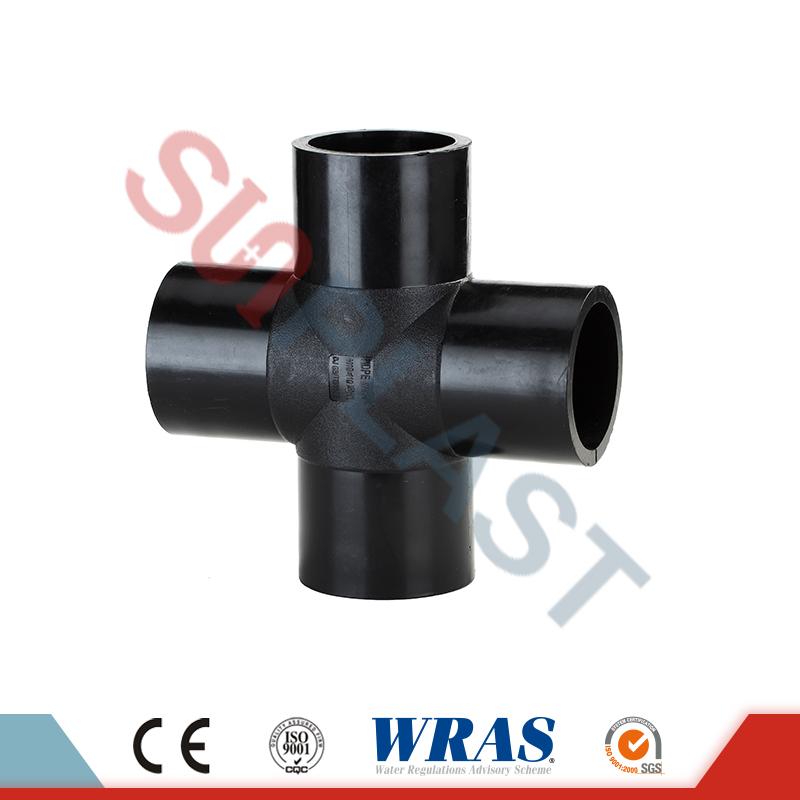
The Dominance of ISO 4427 and ISO 4437 Series
The most universally recognized benchmarks for HDPE Pipe Fittings are the ISO 4427 and ISO 4437 series. ISO 4427 specifically covers piping systems for water supply, while ISO 4437 addresses systems for gaseous fuels. These standards dictate the physical and mechanical properties of the material, the dimensional tolerances, and the long-term performance requirements. A fitting that meets ISO standards is generally accepted in markets across Europe, Asia, Africa, and the Middle East, making it the safest baseline for international trade.
For our production line, adhering to ISO 4427 means that every fitting we produce is subjected to rigorous testing for hydrostatic strength, impact resistance, and melt flow rate. The standards mandate a minimum required strength MRS, which classifies the material as PE80 or PE100. Today, PE100 is the industry workhorse due to its high density and excellent resistance to slow crack growth. Our factory utilizes only premium PE100 raw materials to ensure that our HDPE Pipe Fittings provide a 50-year design life under standard pressure conditions, as stipulated by these international benchmarks.
ASTM Standards in the North American Market
In the United States and Canada, the ASTM International standards hold precedence. For HDPE Pipe Fittings, the most relevant specifications are ASTM D3261 for butt heat fusion fittings and ASTM F2619 for fabricated fittings. Unlike the ISO system, which often uses a dimensional ratio DR to define pressure ratings, ASTM standards typically use the Standard Dimension Ratio SDR. While the mathematics behind SDR and DR is similar, the specific pressure classes and testing protocols can differ.
Navigating these differences requires a flexible manufacturing approach. We have engineered our production processes to accommodate both metric and imperial sizing requirements. When a project specifies ASTM standards, our HDPE Pipe Fittings are manufactured to meet stringent cell classification requirements, such as PE 4710, which denotes a high-performance material with enhanced stress cracking resistance. This dual-compliance capability is a hallmark of our commitment to global markets, ensuring that whether the spec calls for ISO or ASTM, the product delivered is precisely engineered for the application.
EN 12201 and the European Regulatory Framework
Within the European Union, the EN 12201 standard harmonizes the requirements for HDPE piping systems for water supply. Closely aligned with ISO 4427, EN 12201 provides the presumption of conformity with the Construction Products Regulation CPR. This means that HDPE Pipe Fittings sold in the EU must carry the CE mark, indicating they meet these essential health, safety, and environmental protection requirements. The standard places a heavy emphasis on traceability and the declaration of performance.
Our compliance with EN 12201 is not just about passing a test; it is about a systematic approach to quality management. Every batch of raw material is traced, and every production parameter is logged. This meticulous data collection allows us to provide the detailed documentation that European contractors and engineers demand. By ensuring our HDPE Pipe Fittings align perfectly with EN 12201, we simplify the supply chain for our European partners, guaranteeing that the components they receive are fully compliant with local regulations and ready for immediate installation.
Key Dimensional and Performance Parameters
Understanding the standards is one thing; understanding the product parameters they define is another. The following table outlines the critical specifications we adhere to in the production of HDPE Pipe Fittings at Ningbo Sunplast Pipe Co., Ltd. These figures represent the intersection of ISO, EN, and ASTM requirements, ensuring our products are versatile and reliable.
| Parameter | Specification | International Standard Reference |
| Material Grade | PE100 PE4710 | ISO 4427 / ASTM F714 |
| Density | ≥ 0.955 g/cm³ | ISO 1183 / ASTM D1505 |
| Melt Flow Rate MFR | 0.2 - 1.4 g/10min 5kg 190°C | ISO 1133 / ASTM D1238 |
| Minimum Required Strength MRS | 10.0 MPa | ISO 9080 / ASTM D2837 |
| Hydrostatic Strength | No failure during test 20°C / 80°C | ISO 1167 / ASTM D1598 |
| Pressure Rating | PN6 to PN25 SDR11 to SDR26 | ISO 4427-2 / EN 12201-2 |
| Carbon Black Content | 2.0 - 2.5 percent | ISO 6964 / ASTM D4218 |
| Fusion Compatibility | Compatible with all PE80/PE100 pipes | ISO 21307 / ASTM F2620 |
The data presented in this table is the result of continuous investment in quality control and testing equipment at our facility. We understand that engineers and procurement specialists rely on these numbers to validate the safety and longevity of their pipeline networks. By consistently meeting these stringent parameters, our HDPE Pipe Fittings provide the leak-free performance and corrosion resistance that modern infrastructure demands.
Material Quality and Traceability
Standards are only as good as the materials used to meet them. The specification for PE100 material, for instance, guarantees a certain level of performance, but the consistency of that material across millions of units is what defines a reliable supplier. At Sunplast, we source our raw materials exclusively from world-class petrochemical leaders. This ensures that the base resin we use has a consistent molecular weight distribution and additive package, which are crucial for uniform fusion and long-term durability.
Our commitment to traceability goes beyond the material certificate. In our factory, each production batch of HDPE Pipe Fittings is assigned a unique code that links it back to the specific raw material lot, the processing parameters, and the quality control tests performed. This level of detail provides our customers with absolute confidence. If a query arises on site, even years after installation, we can provide the full manufacturing history. This is the practical application of international standards a commitment to accountability and performance that protects our clients investment.
FAQ Common Questions on HDPE Pipe Fitting Standards
What are the key differences between ISO and ASTM standards for HDPE Pipe Fittings, and how do they affect my project?
The primary differences lie in dimensional systems, pressure rating nomenclature, and specific testing protocols. ISO standards, like ISO 4427, generally use metric dimensions and refer to Pressure Nominal PN ratings, such as PN10 or PN16. ASTM standards, such as ASTM D3035, often use imperial dimensions Iron Pipe Size IPS and define pressure ratings based on the Dimension Ratio DR, like DR11 or DR17. From a material perspective, ISO uses the Minimum Required Strength MRS classification PE100, while ASTM uses a cell classification system, with PE4710 being the high-performance equivalent. For your project, the selection depends on the geographical location and the local regulatory framework. A project designed in Europe will typically call for ISO, while a project in North America will require ASTM. Using the correct standard is crucial for ensuring the fitting mates perfectly with the pipe and that the entire system receives the correct regulatory approvals. Our factory produces fittings that meet both sets of criteria, bridging this gap seamlessly.
How can I verify that the HDPE Pipe Fittings I purchase are compliant with international standards?
Verification should be a multi-step process. First, request the manufacturer's test certificates, specifically the Type Test Certificate or third-party certification from a recognized body like DVGW, KIWA, or NSF. These documents confirm that a specific product family has been tested and meets the requirements of the relevant standard, such as EN 12201 or NSF 61. Second, conduct visual inspections and simple dimensional checks upon delivery. The fittings should be clearly marked with the manufacturer's name, the material code PE100, the pressure rating PN or DR, and the applicable standard number. Third, work with suppliers who provide full traceability. At Ningbo Sunplast Pipe Co., Ltd., we provide detailed documentation that includes batch numbers and material certifications. If there is ever a doubt, independent third-party testing of samples can confirm the material properties, such as density, Melt Flow Rate, and carbon black dispersion, against the standard's requirements.
What role do pressure ratings and SDR play in the selection of HDPE Pipe Fittings?
The pressure rating and the Standard Dimension Ratio SDR are the most critical parameters for the hydraulic design of a piping system. The SDR is the ratio of the pipe's outside diameter to its wall thickness. A lower SDR number, such as SDR11, indicates a thicker wall, which allows for a higher pressure rating. Conversely, a higher SDR number, like SDR26, has a thinner wall and a lower pressure rating. When selecting HDPE Pipe Fittings, it is imperative that the fitting has the same SDR or a pressure rating equal to or greater than the pipe being used. This ensures that the entire system maintains a consistent pressure capacity. If a lower-pressure fitting is used with a higher-pressure pipe, the fitting becomes the weak point in the system. Our fittings are manufactured to match the full range of standard SDRs, ensuring that the joint created through butt fusion or electrofusion is as strong as the pipe itself, providing a fully rated, monolithic system.
Conclusion The Importance of Certified Quality
In the final analysis, the key standards for HDPE Pipe Fittings in international markets are the bedrock of trust in a project. They transform a piece of plastic into a certified component of a city's water main or a critical industrial slurry line. For our team, these standards are the daily language of our work. They guide our material selection, dictate our manufacturing parameters, and define our testing protocols. When we mark a fitting with a PN16 or an SDR11 rating, it is a promise validated by international consensus.
Choosing a supplier who understands and consistently delivers against these standards is the most effective risk mitigation strategy a project manager can employ. With our two decades of experience and our dedicated factory in Ningbo, we provide that assurance. Whether the requirement is for potable water certifications from WRAS or ACS, or for gas compliance from DVGW, our HDPE Pipe Fittings are engineered to pass the test. We invite you to work with a partner who speaks the global language of quality fluently and who stands behind every product with the integrity that comes from a deep-rooted commitment to industry best practices.