

What Factors Should Be Considered When Buying an Agricultural Gearbox?
2026-07-31
1. How Do You Match the Gearbox Torque Rating to Your Implement?
In our factory, the most common mistake buyers make is selecting an Agricultural gearbox based on horsepower alone, without considering the actual torque demand. Torque is the rotational force required to drive the implement, and it varies with the type of operation. A rotary tiller needs high torque at low speed, while a spreader may need moderate torque at higher speed. Our Saifu Vietnam Company Limited recommends calculating the maximum torque using the formula: Torque (Nm) = 9550 × Power (kW) / RPM. Then add a safety factor of 1.2 to 1.5 for shock loads. For example, a 75 kW tractor at 540 RPM PTO gives 1326 Nm, so you need an Agricultural gearbox rated at least 1600 Nm. We have seen customers under size their gearbox, leading to premature gear tooth breakage. Our catalog lists the continuous and intermittent torque ratings for each model. Always choose the rating that matches your peak load, not the average.
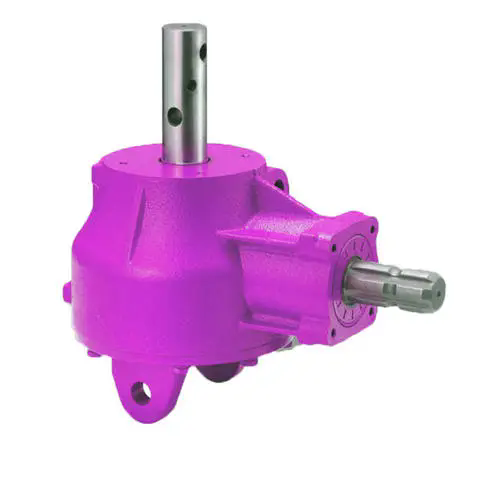
2. Why Is the Gear Ratio Critical for Your Specific Application?
Gear ratio determines the output speed and torque multiplication. For heavy tillage, you need a reduction ratio of 3:1 to 5:1 to increase torque. For PTO driven generators, you may need a 1:1 ratio. Our factory produces Agricultural gearbox with ratios from 1:1 to 8:1. The table below shows typical ratio recommendations for common implements.
| Implement type | Recommended gear ratio | Output RPM (at 540 input) | Typical torque requirement |
| Rotary tiller (heavy soil) | 4:1 to 5:1 | 108 – 135 RPM | High torque |
| Rotary mower | 2:1 to 3:1 | 180 – 270 RPM | Medium torque |
| Auger / conveyor | 1.5:1 to 2:1 | 270 – 360 RPM | Low to medium torque |
| Spreader (fertilizer) | 1:1 to 1.5:1 | 360 – 540 RPM | Low torque |
| Post hole digger | 6:1 to 8:1 | 68 – 90 RPM | Very high torque |
Our Saifu Vietnam Company Limited can customize the gear ratio to match your specific PTO speed and implement requirements. We also offer two speed gearboxes for applications that need both high torque and high speed modes.
3. What Materials and Manufacturing Quality Should You Look For?
The durability of an Agricultural gearbox depends on the housing material and gear metallurgy. We recommend ductile iron housing (GGG50) because it absorbs shock better than gray iron. The gears should be case hardened to 58–62 HRC with a core hardness of 30–35 HRC. Our factory uses helical gears for smoother operation and higher load capacity. Straight cut gears are cheaper but noisier and weaker. The table below compares our standard specifications with lower quality alternatives.
| Component | Our Agricultural gearbox (premium) | Economy gearbox (typical) |
| Housing material | Ductile iron GGG50 | Gray iron (lower impact resistance) |
| Gear type | Helical ground | Straight cut or non ground |
| Gear hardness (surface) | 58 – 62 HRC | 45 – 50 HRC |
| Bearing brand | SKF or NTN | Local generic |
| Seal type | Double lip with dust excluder | Single lip |
We also recommend checking the gearbox for proper assembly. Our factory performs a 100 percent run in test under load before shipping. This ensures that the gears have meshed correctly and there are no foreign particles inside. Saifu Vietnam Company Limited provides a test report with every Agricultural gearbox, including vibration and temperature data.
4. How Does the Mounting Configuration Affect Installation and Reliability?
The mounting arrangement must match your implement frame. Common types include foot mount, flange mount, and shaft mount. Our Agricultural gearbox is available with all three options. Foot mount is versatile but requires a rigid base. Flange mount is compact and ideal for direct coupling to the machine. Shaft mount is used for conveyors where the gearbox hangs directly on the driven shaft. We have also seen cases where incorrect mounting caused misalignment and bearing failure. Our factory provides detailed installation drawings for each model. We also recommend using a torque arm to prevent rotation on shaft mounted units. The input and output shaft orientations – parallel, right angle, or coaxial – must also be considered. For example, a right angle Agricultural gearbox is preferred for mowers because it transfers power to a horizontal blade drive. Our Saifu Vietnam Company Limited offers both parallel and right angle configurations.
Frequently Asked Questions About Buying an Agricultural Gearbox
Final Summary
Choosing the right Agricultural gearbox requires careful evaluation of torque, ratio, materials, mounting, and support services. A well selected gearbox will provide years of reliable service and reduce downtime. Our factory has helped thousands of farmers and contractors make the right choice. Our Saifu Vietnam Company Limited offers a complete range of gearboxes backed by rigorous testing and a strong warranty.