

What Is the Difference Between Flat Face and Raised Face?
2026-09-17
1. How Does the Raised Face Geometry Affect Gasket Seating Stress?
The raised face on a flange is a circular ridge that extends 1.6 mm to 6.4 mm above the bolting plane, depending on the flange size and pressure class. When the flange is bolted to its mating flange, the raised faces contact the gasket, and the bolt load is concentrated on the small area of the raised ring. This concentration is the key to the sealing mechanism. The bolt load is distributed over a smaller area, which increases the contact stress on the gasket. Higher contact stress means better sealing, especially for high-pressure applications. A flat face flange has no raised ring, so the gasket sits on the full face of the flange, including the area around the bolts. The bolt load is distributed over a larger area, which reduces the contact stress on the gasket.
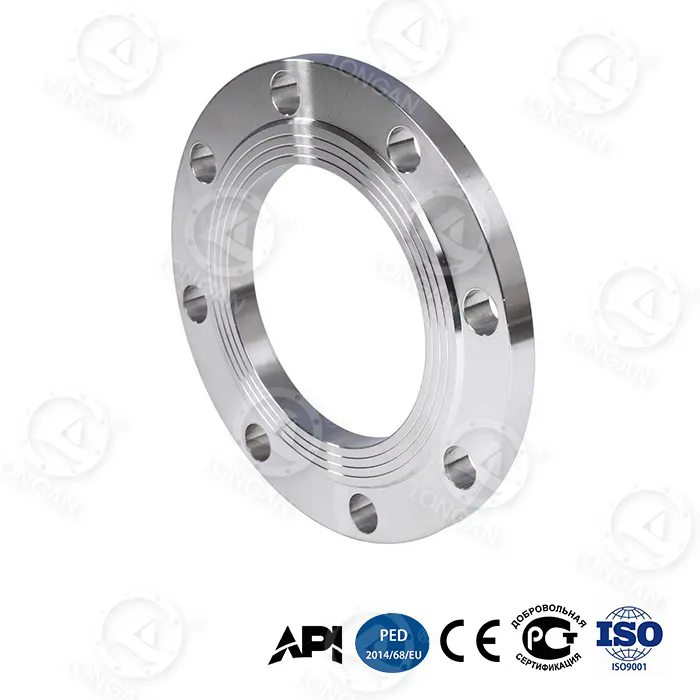
The table below compares the contact stress for the two face types under the same bolt load.
| Flange face type | Gasket contact area (for 4 inch class 150) | Bolt load (typical) | Gasket contact stress |
| Raised face (RF) | ~ 3,100 mm² | 40,000 N | 12.9 MPa |
| Flat face (FF) | ~ 5,800 mm² | 40,000 N | 6.9 MPa |
The higher contact stress of the raised face design is why it is the standard choice for ASME B16.5 flanges in pressure classes 300 and above. For lower pressure classes (150 and 300), a flat face flange can be used, but the gasket must be softer or the bolt load must be higher to achieve the same sealing stress. Wenzhou Longan Flange Co., Ltd. manufactures both flat face and raised face flanges in a full range of sizes and pressure classes. Our factory machines the raised face to a height of 1.6 mm for classes 150 and 300, and 6.4 mm for classes 600 and above, in accordance with ASME B16.5.
2. Why Is a Flat Face Flange Used for Low Pressure and Cast Iron Applications?
The flat face flange is the standard choice for low-pressure applications and for mating with cast iron or bronze equipment. The reason is related to the strength of the mating material. Cast iron is brittle and has low tensile strength. If a raised face flange is bolted against a cast iron flange, the concentrated bolt load on the raised ring can crack the cast iron. A flat face flange distributes the bolt load over a larger area, which reduces the risk of cracking. This is why flat face flanges are commonly used on pump casings, valve bodies, and other equipment made from cast iron. The flat face design is also used when the mating flange is made from a different material with a different coefficient of thermal expansion. The larger contact area of the flat face provides more tolerance for differential movement. The table below summarizes the typical applications for each face type.
| Application | Recommended face type | Reason |
| Cast iron valve or pump | Flat face | Prevents cracking of brittle material |
| Class 150 steel piping | Raised face or flat face | Both are acceptable; RF is more common |
| Class 300 and above | Raised face | Higher contact stress required for sealing |
| Mating with non-metallic equipment | Flat face | Distributes load over larger area |
| High temperature steam | Raised face | Better creep resistance at high stress |
In our factory, we produce flat flange units with a smooth finish (Ra 3.2 to 6.3 microns) for use with non-asbestos gaskets. We also produce raised face flanges with a serrated finish (Ra 3.2 to 12.5 microns) for spiral wound gaskets. The surface finish is as important as the face type because it affects the gasket grip and the sealing performance.
3. How Do Bolt Load and Gasket Type Differ Between Flat Face and Raised Face?
The bolt load required to achieve a proper seal depends on the gasket type and the face type. For a raised face flange, the gasket is typically a spiral wound or ring joint type that requires a high seating stress. The bolt load must be sufficient to compress the gasket into the serrations on the raised face. For a flat face flange, the gasket is typically a full-face or sheet gasket that requires a lower seating stress. The bolt load can be lower, but the larger gasket area means that the total force required to achieve the necessary stress may be similar. The table below shows the recommended bolt loads for different gasket types and face types.
| Gasket type | Face type | Recommended seating stress (MPa) | Bolt load for 4 inch class 150 (N) |
| Spiral wound (SS316 + graphite) | Raised face | 70 | 217,000 |
| Spiral wound (SS316 + graphite) | Flat face | 70 | 406,000 |
| Non-asbestos sheet (3 mm) | Flat face | 20 | 116,000 |
| Non-asbestos sheet (3 mm) | Raised face | 20 | 62,000 |
| Ring joint (soft iron) | Raised face (grooved) | 120 | 372,000 |
The bolt load data shows that a flat face flange with a spiral wound gasket requires nearly twice the bolt load of a raised face flange with the same gasket. This is because the gasket area is larger. In practice, this means that flat face flanges require larger bolts or a higher bolt stress to achieve the same sealing performance. This is one of the reasons why raised face flanges are preferred for high-pressure applications. Wenzhou Longan Flange Co., Ltd. provides bolt load calculation sheets with our flanges to help our customers select the correct bolt size and torque.
4. What Are the Installation and Maintenance Implications of Each Face Type?
The installation and maintenance requirements differ between flat face and raised face flanges. A raised face flange requires that the mating flange also has a raised face of the same height and diameter. If a raised face flange is bolted to a flat face flange, the raised face will not seat properly, and the joint will leak. This is a common mistake in the field. A flat face flange can be bolted to another flat face flange, but it should not be bolted to a raised face flange without a spacer or adapter. The surface finish also matters. A raised face flange with a serrated finish should not be used with a soft gasket that can be damaged by the serrations. A flat face flange with a smooth finish is more forgiving for soft gaskets. In terms of maintenance, a raised face flange is easier to inspect because the gasket is visible between the raised faces. A flat face flange requires that the joint be disassembled to inspect the gasket. In our factory, we mark the face type on the flange rim to prevent installation errors.
Frequently Asked Questions About Flat Face and Raised Face Flanges
Summary for Piping Engineers and Procurement Specialists
The difference between flat face and raised face flanges is not just geometric. It affects the gasket seating stress, the bolt load, the pressure rating, and the installation requirements. Raised face flanges are the standard choice for high-pressure steel piping because they concentrate the bolt load on a small area and achieve higher contact stress. Flat face flanges are the standard choice for low-pressure applications and for mating with cast iron or brittle materials because they distribute the bolt load over a larger area. The selection should be based on the pressure class, the mating material, and the gasket type. Wenzhou Longan Flange Co., Ltd. manufactures both flat face and raised face flanges in a full range of sizes and pressure classes.
Wenzhou Longan Flange Co., Ltd. manufactures flat face and raised face flanges to ASME B16.5 and DIN standards. We provide material certificates, dimensional inspection reports, and gasket recommendations for all of our products.
Need help selecting the right flange face type for your application? Contact Wenzhou Longan Flange Co., Ltd. for a free consultation. We will review your piping conditions and recommend the optimal flange configuration.