

What Makes a Winding Resistance Test Essential for Transformer Reliability?
2026-09-30
Transformers are expected to operate reliably under demanding electrical loads, but hidden problems inside windings, connections, and tap changers may not be visible during a routine visual inspection. A Winding Resistance Test provides an effective way to evaluate the condition of the current-carrying path by measuring the DC resistance of transformer windings. For manufacturers, maintenance teams, and electrical contractors, this test can provide valuable information about connection quality, winding consistency, and potential abnormalities before they develop into more serious operating problems.
For professional electrical testing applications, Weshine Electric Manufacturing Co., Ltd. provides testing solutions designed to help users obtain stable and repeatable winding resistance measurements. By combining appropriate test current, accurate measurement, and practical operating functions, winding resistance testing can become an important part of transformer manufacturing, commissioning, maintenance, and troubleshooting.
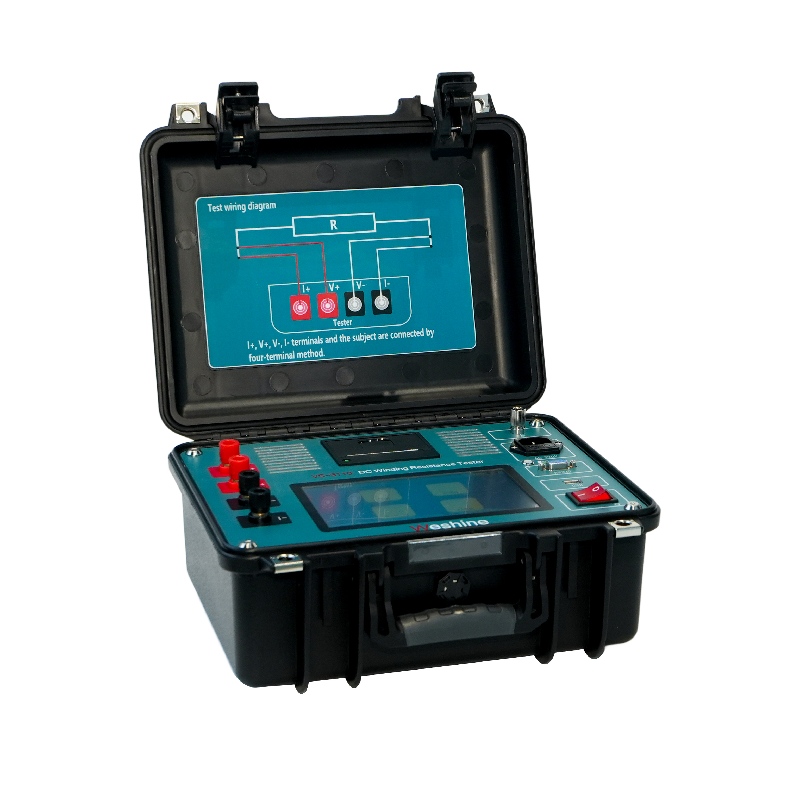
What Does a Winding Resistance Test Measure?
A Winding Resistance Test measures the DC resistance of a transformer winding. In a typical test, controlled DC current is applied to the winding while the resulting voltage drop is measured. The resistance value is then determined according to the relationship between voltage and current.
Because transformer windings are inductive, the measured value may take time to stabilize after the test current is applied. The test therefore requires suitable current selection, secure connections, sufficient settling time, and careful recording of winding temperature.
The measured resistance can help technicians evaluate:
-
Winding conductor continuity
-
Connection and joint quality
-
Phase-to-phase resistance consistency
-
Tap changer contact condition
-
Possible loose or deteriorated connections
-
Changes compared with previous test results
-
Potential abnormalities following transportation, installation, repair, or faults
The purpose is not simply to obtain a resistance number. The greater value comes from comparing the measurement with appropriate reference data and evaluating changes over time.
Why Is Winding Resistance Testing Important?
A transformer may continue to operate even when a connection or winding component has begun to deteriorate. However, increased resistance at a connection can contribute to localized heating and additional losses. An abnormal resistance value may also indicate a problem that requires further investigation.
A Winding Resistance Test can therefore support several stages of a transformer's service life.
| Application Stage | Main Purpose |
|---|---|
| Factory testing | Verify winding and connection quality |
| Installation | Establish a field reference after transportation |
| Commissioning | Confirm electrical continuity before operation |
| Routine maintenance | Monitor changes in winding condition |
| After repair | Verify repaired connections and components |
| Troubleshooting | Investigate abnormal heating or electrical behavior |
For transformers equipped with tap changers, measurements can also be taken across different tap positions. Changes in resistance between positions may provide useful information about the condition of the tap-changing circuit.
How Does the Test Improve Transformer Maintenance?
One of the most useful effects of winding resistance testing is early condition assessment. Instead of waiting until a transformer experiences abnormal heating, unstable operation, or an unexpected outage, maintenance personnel can compare current measurements with previous records.
For example, a significant difference between phases may indicate an abnormal connection or winding condition. A resistance value that changes noticeably over time can also justify additional diagnostic testing.
This creates a practical maintenance cycle:
-
Measure the winding resistance.
-
Record the result together with temperature and tap position.
-
Compare the value with factory or previous measurements.
-
Identify unusual differences or trends.
-
Investigate the suspected component.
-
Repair or maintain the transformer when necessary.
-
Retest to confirm the result.
This approach helps transform a single electrical measurement into useful maintenance information.
What Factors Affect Winding Resistance Measurements?
Accurate testing requires more than simply connecting a tester to a transformer. Several factors can influence the measurement.
Winding Temperature
Copper and other winding conductors change resistance with temperature. Therefore, measurements taken at different temperatures should not be compared directly without appropriate temperature consideration.
Test Current
The test current should be selected according to the winding and instrument requirements. Excessive current can heat the winding and influence the measured resistance, while insufficient current may make the measurement less stable.
Stabilization Time
A transformer winding has inductive characteristics. After DC current is applied, the reading may need time to reach a stable condition. Recording a value too early can produce inconsistent results.
Connection Quality
Loose test leads, dirty terminals, or unsuitable connections can introduce additional resistance into the measurement. A proper four-wire measurement arrangement can reduce the influence of lead resistance, which is particularly useful when measuring low resistance values.
Which Problems Can a Winding Resistance Test Help Identify?
A resistance measurement does not independently diagnose every transformer fault, but it can provide important evidence when combined with other inspection and electrical test results.
Typical abnormalities that may be investigated include:
-
Loose winding connections
-
Poor or deteriorated electrical joints
-
Broken conductor strands
-
Abnormal phase resistance
-
High contact resistance in tap changers
-
Open-circuit conditions
-
Certain winding connection problems
-
Changes caused by transportation or mechanical stress
For this reason, winding resistance testing is often used together with other transformer diagnostic methods rather than being treated as an isolated pass-or-fail procedure.
How Is a Winding Resistance Test Performed?
A typical testing process can be organized into several steps.
1. De-energize and isolate the transformer
The transformer must be safely disconnected from the electrical system before testing.
2. Select the appropriate test points
The test points depend on the transformer winding configuration and the testing objective.
3. Connect the test leads
Secure and correct connections are essential for reliable measurements.
4. Apply controlled DC current
The tester injects DC current into the selected winding and measures the corresponding voltage response.
5. Wait for the reading to stabilize
The operator should allow sufficient settling time before recording the final resistance value.
6. Record the measurement
Record resistance, temperature, phase, tap position, and other relevant test information.
7. Compare the results
Compare the values between phases, tap positions, previous measurements, or suitable factory reference data.
8. Complete the test safely
After measurement, the winding should be properly discharged and the test equipment disconnected according to the instrument manufacturer's procedures.
Weshine Electric: Supporting More Efficient Electrical Testing
For professional transformer testing, measurement stability and operating convenience are important considerations. Weshine Electric Manufacturing Co., Ltd. focuses on electrical testing equipment and solutions designed for applications where reliable measurement data is essential.
A suitable winding resistance tester can help users simplify routine testing by integrating functions such as controlled test current, accurate resistance measurement, data display, result recording, and practical testing workflows.
For manufacturers, testing laboratories, electrical contractors, and maintenance teams, the value of the equipment extends beyond obtaining a resistance reading. Reliable testing can help establish consistent quality-control procedures and provide useful reference data for future maintenance.
What Makes Winding Resistance Testing a Practical Choice?
The effectiveness of a Winding Resistance Test comes from its ability to turn a relatively simple electrical measurement into useful information about transformer condition.
Its main benefits include:
-
Quality verification: Helps verify winding and connection consistency.
-
Maintenance support: Provides reference data for condition monitoring.
-
Fault investigation: Helps identify abnormal resistance conditions.
-
Commissioning support: Creates baseline records before a transformer enters service.
-
Repair verification: Helps confirm whether maintenance work has restored the expected electrical condition.
-
Long-term monitoring: Historical test results can reveal changes that may otherwise remain unnoticed.
When properly performed and interpreted, the test can become a valuable part of a broader transformer maintenance strategy.
Conclusion
A transformer winding may be hidden from direct inspection, but its electrical resistance provides measurable information about the condition of its current-carrying path. A properly performed Winding Resistance Test can help verify connections, compare phase conditions, evaluate tap changer circuits, establish maintenance baselines, and investigate abnormal electrical behavior.
For organizations looking for dependable electrical testing equipment, Weshine Electric Manufacturing Co., Ltd. offers professional solutions for winding resistance measurement and other electrical testing applications. Whether the requirement involves transformer manufacturing, commissioning, routine maintenance, or troubleshooting, selecting the appropriate testing equipment can make measurement more efficient and help users obtain meaningful and repeatable results.
For more information about Winding Resistance Test solutions, testing equipment, and application requirements, contact us to discuss your specific testing needs with Weshine Electric Manufacturing Co., Ltd.