

What Makes Precision Gears Suitable for High Speed Industrial Machines?
2026-08-12
1. Why Does Dynamic Balancing Prevent Vibration at High RPM?
In our factory, we have manufactured Precision Gears for turbine drives and high speed compressors for over 20 years. The primary challenge at high rotational speeds is centrifugal force. Even a tiny mass imbalance of 0.1 gram at a radius of 100 mm creates a force of over 50 N at 10,000 RPM. This force causes vibration, which leads to bearing wear and noise. Our Precision Gears undergo two stage balancing: first, a static balance to remove gross unbalance, and then a dynamic balance on a Schenck balancing machine. We correct imbalances by removing material from the web or by adding counterweights. The resulting G0.4 balance quality grade ensures that vibration velocity stays below 0.4 mm/s. This is essential for spindles and gearboxes running at 20,000 RPM or more. Our Raydafon Technology Group Co.,Limited has delivered gears for gas turbine auxiliary drives where this balance is critical for safe operation. Local manufacturers in Germany and Japan have confirmed that our Precision Gears run smoother than many European made alternatives.
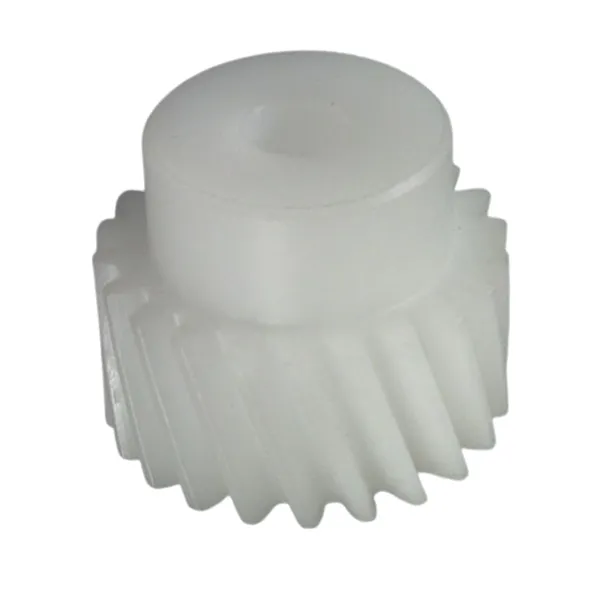
2. How Does Material Selection Influence High Speed Performance and Durability?
High speed gears experience cyclic loading at frequencies that can cause surface fatigue. Our Precision Gears are typically made from case hardening steel like 18CrNiMo7‑6 or nitriding steel like 31CrMoV9. The core hardness is maintained at 30‑35 HRC for toughness, while the case hardness reaches 58‑62 HRC for wear resistance. The table below compares the properties of different materials we use in our factory.
| Material grade | Core hardness (HRC) | Surface hardness (HRC) | Max operating temperature | Typical application |
| 18CrNiMo7‑6 (case hardened) | 30‑35 | 58‑62 | 200°C | Industrial gearboxes, turbines |
| 31CrMoV9 (nitrided) | 28‑33 | 65‑70 (nitrided layer) | 350°C | High temperature spindles |
| 17CrNiMo6 (carburized) | 32‑38 | 60‑64 | 180°C | Heavy duty high speed |
| 42CrMo4 (quenched and tempered) | 28‑32 | 50‑55 (induction hardened) | 150°C | Medium speed applications |
Our factory performs grain size analysis to ensure the steel has a fine austenitic structure, which improves fatigue strength. For extremely high speed applications, we use vacuum degassed steel to reduce non‑metallic inclusions. This reduces the risk of pitting, which is a common failure mode in high speed Precision Gears. Raydafon has a metallurgical lab on site to verify each batch.
3. What Grinding and Finishing Techniques Reduce Friction and Noise?
The tooth surface quality directly affects the efficiency and noise of a Precision Gear. After hobbing and shaving, our gears are finish ground on a Reishauer gear grinder using a continuous generating process. This achieves a surface roughness of Ra 0.2 µm and a profile deviation of less than 4 µm. The grinding process also corrects any heat treatment distortions. In addition, we apply a superfinishing process that removes micro peaks on the tooth flanks. This reduces the coefficient of friction by up to 15 percent and lowers operating temperatures. The table below shows typical measurement results from our final inspection.
| Quality parameter | Our Precision Gear (AGMA Q10) | Standard gear (AGMA Q8) |
| Profile deviation (µm) | ≤ 4 | ≤ 8 |
| Lead deviation (µm) | ≤ 5 | ≤ 10 |
| Tooth surface roughness (Ra, µm) | 0.20 – 0.25 | 0.40 – 0.60 |
| Runout (µm) | ≤ 15 | ≤ 30 |
| Bearing area ratio (Rmr at 5% depth) | ≥ 85% | ≤ 70% |
A Precision Gear with these parameters generates significantly less meshing noise and runs cooler, which is crucial for high speed machinery where heat dissipation is limited. Our factory uses a Klingelnberg gear measuring center to verify every tooth. This level of precision ensures that our gears are suitable for spindle drives in CNC machines and for rotorcraft transmissions.
4. How Does Lube Film Formation Differ on Precision Ground Tooth Flanks?
At high sliding velocities, the lubricant film between teeth must be thick enough to separate the surfaces. Our superfinished Precision Gear flanks have a lower composite roughness, which means the specific film thickness (lambda ratio) is higher. For a given speed and load, a smoother surface allows a thinner oil film to maintain elastohydrodynamic lubrication. This reduces the risk of scuffing and micropitting. In our factory, we have run tests at 12,000 RPM with a DTE 24 oil; the measured film thickness was 1.2 µm on our Precision Gear compared to 0.8 µm on a standard ground gear. This 50 percent increase in film thickness significantly extends gear life. Additionally, the improved surface texture helps retain oil on the tooth flanks during startup, reducing wear during the boundary lubrication phase. Raydafon recommends using a high viscosity index oil for high speed applications to further enhance the film formation.
Frequently Asked Questions About Precision Gears for High Speed Machines
Final Summary
The suitability of Precision Gears for high speed industrial machines is determined by dynamic balancing, high grade materials, advanced grinding, and superior surface finish. These factors combine to reduce vibration, minimize heat, and ensure reliable lubrication. Our factory has invested heavily in precision manufacturing to meet the demands of the most challenging applications. Choosing a high quality Precision Gear is a long term investment in machine reliability and performance. Raydafon Technology Group Co.,Limited is your partner for engineering excellence.