

What Makes QGM Block Making Machine Suitable for High Output Factories?
2026-08-26
1. How Does Cycle Time Translate Into Daily Output?
Cycle time is the most visible metric, but it is often misunderstood. A machine that claims a 10 second cycle but produces blocks with inconsistent density is not a high output machine—it is a high reject machine. Our QGM Block Making Machine achieves a cycle time of 12 to 15 seconds for standard 400x200 mm hollow blocks, but it does so while maintaining a compaction height variation of less than 0.3 mm. This consistency comes from the closed loop hydraulic system that adjusts pressure in real time based on material feedback.
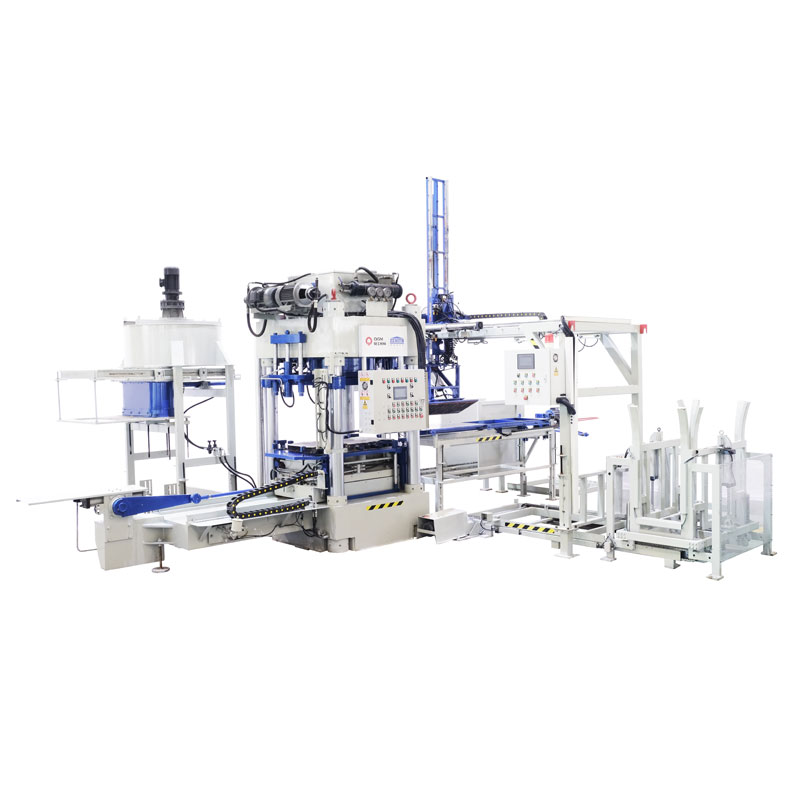
The table below shows the output potential of our QGM Block Making Machine across different shift configurations.
| Shift configuration | Cycles per hour | Blocks per hour (4 per cycle) | Blocks per day | Blocks per year (300 days) |
| Single shift (8 hours) | 240 – 280 | 960 – 1120 | 7,680 – 8,960 | 2.3 – 2.7 million |
| Double shift (16 hours) | 240 – 280 | 960 – 1120 | 15,360 – 17,920 | 4.6 – 5.4 million |
| Triple shift (24 hours) | 240 – 280 | 960 – 1120 | 23,040 – 26,880 | 6.9 – 8.1 million |
What this table does not show is the reject rate. In our factory trials, the QGM Block Making Machine consistently achieves a reject rate below 1.2 percent, even on triple shift operation. This is not a theoretical number; it comes from real production data collected from plants in Vietnam and Indonesia. A machine that produces faster but with a 3 percent reject rate will actually deliver fewer good blocks per day. The QGM Block Making Machine is designed to prioritize good output, not just raw speed.
2. What Keeps the Machine Running When the Factory Never Stops?
High output factories run 24/7. The machine must be able to handle continuous operation without overheating, without hydraulic fluid degradation, and without mechanical fatigue. Our QGM Block Making Machine is built with oversized hydraulic oil coolers that maintain oil temperature below 55°C even at full load. We use induction hardened guide rods that resist wear for over 10,000 operating hours. The main bearings are rated for a service life of 20,000 hours. But beyond the components, the machine includes a diagnostic system that monitors vibration, temperature, and pressure in real time. If a parameter drifts, the system alerts the operator before a failure occurs. This predictive maintenance capability is essential for high output factories because it allows maintenance to be scheduled during shift changes rather than as an emergency shutdown. One of our customers in Malaysia operates two QGM Block Making Machines on triple shift and has recorded an average uptime of 94 percent over 18 months. That is the kind of reliability that high output factories depend on.
3. How Does Automation Reduce Labor Dependency?
Labor is becoming more expensive and harder to find in many regions. A high output factory cannot rely on manual stacking, manual pallet feeding, or manual mold lubrication. The QGM Block Making Machine integrates with a fully automatic system that includes pallet conveyor, automatic mold oil spraying, and robotic stacking. The stacking robot can handle up to 30 cycles per hour, which matches the machine's output. This means that a single operator can supervise the entire line. In our factory, we have demonstrated that a QGM Block Making Machine equipped with full automation can produce the same output as a semi automatic line with 8 workers. The payback period for the automation investment is typically less than 18 months, based on labor cost savings alone. For a high output factory planning to scale, this automation compatibility is not a luxury—it is a necessity. The QGM Block Making Machine is designed to integrate with existing automation systems, not to require a complete replacement of your material handling equipment.
4. How Does the Machine Handle Raw Material Variations Without Sacrificing Quality?
High output factories often use locally sourced aggregates that vary in moisture content and particle size. A machine that is too rigid will produce inconsistent blocks. Our QGM Block Making Machine includes a variable frequency drive on the vibration system that adjusts amplitude and frequency based on the material feedback from the hydraulic pressure sensor. If the mix is wetter, the machine automatically reduces the vibration frequency to prevent bleeding. If the mix is drier, it increases the frequency to achieve full compaction. This adaptive control means that the QGM Block Making Machine can produce consistent blocks even when the raw material changes from batch to batch. In our factory, we have tested the machine with cement contents ranging from 6 percent to 14 percent, and the resulting blocks still met ASTM C90 standards. For a high output factory that cannot afford to reject entire batches because of material variation, this adaptability is a critical advantage.
Frequently Asked Questions About QGM Block Making Machine for High Output Production
Final Summary
High output factories need a machine that delivers consistent daily output, minimizes downtime, reduces labor costs, and adapts to raw material variations. The QGM Block Making Machine meets all of these requirements through its optimized cycle time, robust cooling and diagnostic systems, automation integration, and adaptive vibration control. It is not just a fast machine; it is a reliable, maintainable, and scalable solution for factories that aim to produce millions of blocks per year. Quangong Machinery Co., Ltd. has been supplying these machines to the world's most demanding production environments for over two decades.