

What Materials Are Used for High Quality PEX-AL-PEX Pipe Fittings?
2026-09-01
A pipe fitting is not a single component. It is an assembly of different materials, each chosen for a specific function. The metal body provides mechanical strength, the coating protects against corrosion, the polymer seals ensure leak tightness, and the crimp ring holds everything together. When a fitting fails, it is rarely the whole fitting that failed—it is one of these material choices that was wrong for the application. This article dissects a typical PEX-AL-PEX Pipe Fitting into its constituent materials and explains why each material is selected.
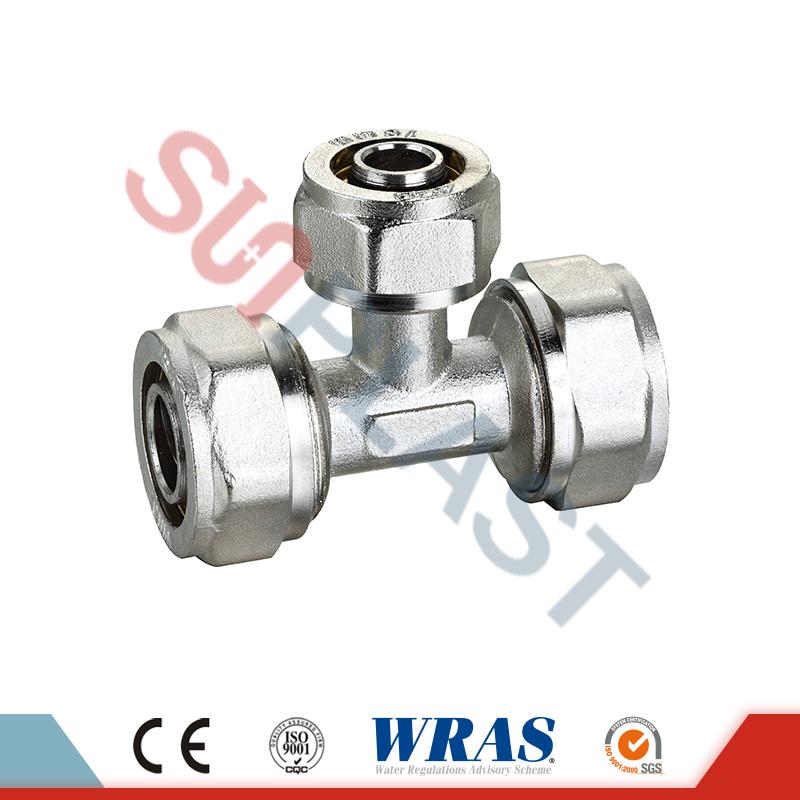
1. Why Is CW617N Brass the Industry Standard for Fitting Bodies?
The body of a press fitting for PEX-AL-PEX pipe is almost universally made from brass. But not all brass is the same. The industry standard is CW617N, which is a lead free brass alloy with a composition of about 57 percent copper, 3 percent lead, and the balance zinc. It is chosen because it combines good machinability with resistance to dezincification. Dezincification is a corrosion process where zinc leaches out of the brass, leaving behind a porous copper structure that is weak and leak prone. CW617N includes a small addition of arsenic or tin to inhibit dezincification. In our factory, we source CW617N bars that are certified to EN 12165 and we perform a dezincification test on every batch. The table below shows the chemical composition of CW617N compared to a lower grade brass commonly used in cheap fittings.
| Element | CW617N (high quality) | Common low grade brass | Why it matters |
| Copper (Cu) | 57 – 59% | 55 – 57% | Higher copper improves corrosion resistance |
| Lead (Pb) | 2.0 – 3.0% | 3.5 – 4.5% | Lower lead reduces leaching into drinking water |
| Zinc (Zn) | Balance | Balance | Controlled to prevent dezincification |
| Arsenic (As) | 0.08 – 0.15% | Not added | Inhibits dezincification |
| Tin (Sn) | 0.1 – 0.2% | None | Improves corrosion resistance |
The brass body of a PEX-AL-PEX Pipe Fitting must also have sufficient wall thickness to resist the hoop stress from the pipe pressure. Our factory designs fittings with a minimum wall thickness of 1.8 mm for 16 mm pipe fittings, which is 0.3 mm thicker than the minimum required by EN 1254. This margin ensures the fitting can withstand pressure surges in the system.
2. What Coating Materials Protect the Fitting Against Corrosion?
Brass is naturally corrosion resistant, but when exposed to aggressive water (low pH, high chloride, or soft water), it can still corrode. This is especially true in heating systems where water is continuously heated and deoxygenated. For this reason, high quality PEX-AL-PEX Pipe Fittings are coated. The most common coating is a nickel plating, which provides a hard, corrosion resistant surface. In our factory, we use an electroless nickel plating process that deposits a uniform layer of 5 to 8 microns. This is superior to electrolytic nickel plating because it covers internal threads and blind holes without the need for an electrical connection. Some fittings use a thin layer of tin plating for food contact applications, while others use a zinc nickel alloy coating for marine environments. The table below compares the corrosion resistance of different coating options.
| Coating type | Typical thickness | Salt spray resistance (hours) | Application suitability |
| Electroless nickel (our standard) | 5 – 8 microns | 480 hours | Potable water, heating systems |
| Electrolytic nickel | 4 – 6 microns | 240 hours | Dry environments, indoor plumbing |
| Tin plating | 2 – 4 microns | 120 hours | Food contact, stainless steel connections |
| Zinc nickel alloy | 8 – 12 microns | 720 hours | Marine, aggressive environments |
| No coating (bare brass) | N/A | 96 hours | Only for non aggressive water |
Our Ningbo Sunplast Pipe Co., Ltd. uses electroless nickel as the standard for all PEX-AL-PEX Pipe Fittings because it provides an excellent balance of corrosion resistance, appearance, and cost. The coating is also lead free, which is important for drinking water applications.
3. What Polymer Materials Are Used for Sealing Elements?
The sealing element in a press fitting is the component that fails most often if the wrong material is chosen. For high quality PEX-AL-PEX Pipe Fittings, the O ring must be compatible with the fluid being carried and the temperature range of the system. The most common sealing material is EPDM (ethylene propylene diene monomer), which is suitable for hot water and heating systems up to 110°C. For cold water only, a nitrile rubber (NBR) seal may be used, but it cannot handle high temperatures. For systems that carry oils or chemicals, a fluorocarbon (FKM or Viton) seal is required. The hardness of the seal is also important; we use a Shore A hardness of 70 to 75 for EPDM seals, which provides a good balance between compression set resistance and sealing force. In our factory, we perform a compression set test on every batch of seals, ensuring that the permanent deformation after 24 hours at 100°C is less than 20 percent. This guarantees that the seal will maintain its integrity over the life of the fitting.
4. How Does the Crimp Ring Material Affect Installation Reliability?
The crimp ring is the part that compresses the pipe onto the fitting body. It is made from stainless steel or copper, depending on the fitting system. For most press fittings, stainless steel is preferred because it does not corrode and has high tensile strength. In our factory, we use AISI 304 stainless steel for our crimp rings. The ring is annealed to make it soft enough to deform during pressing, but hard enough to maintain the compression force. The thickness of the ring is critical: too thin and it will not provide enough radial force; too thick and it will not deform fully during pressing. Our crimp rings are designed to provide a 0.5 mm reduction in the pipe wall diameter when pressed, creating a leak proof joint. We test every batch of crimp rings by performing a pull out test at 2.5 times the rated working pressure. The ring material must also be free from sharp edges that could score the pipe surface. Our factory has developed a polishing process for the inside of the ring to ensure a smooth contact surface.
Frequently Asked Questions About PEX-AL-PEX Pipe Fitting Materials
Final Summary
The quality of a PEX-AL-PEX Pipe Fitting is determined by the materials selected for each component: the brass body, the protective coating, the polymer seal, and the crimp ring. Each material has a specific function and must be chosen to match the application conditions. Cutting corners on any of these materials compromises the reliability of the entire plumbing system. Our factory has been manufacturing pipe fittings for over 18 years, and we have refined our material specifications based on field performance data. Ningbo Sunplast Pipe Co., Ltd. supplies fittings that meet international standards and are backed by full material traceability.