

What Operating Conditions Are Best Suited for Graphite PTFE Filament Packing?
2026-01-29
In industrial sealing applications, temperature and pressure are often the first operating conditions engineers evaluate. For pumps and valves handling aggressive media, stability across a wide operating envelope is essential. Graphite PTFE Filament Packing is widely recognized in North American and European plants for its ability to maintain sealing integrity under fluctuating thermal and mechanical loads.
From our experience supplying chemical processing, pulp and paper, and power generation facilities, this packing performs consistently in moderate to high temperature environments where conventional PTFE or braided packings begin to creep or cold flow. Our production process focuses on uniform filament impregnation and controlled braiding tension, ensuring predictable compression behavior even during thermal cycling.
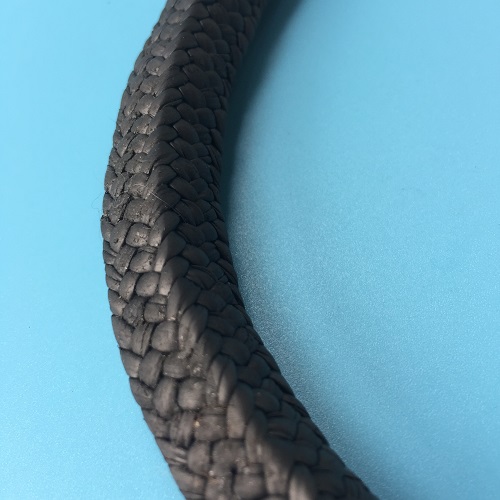
At Ningbo Kaxite Sealing Materials Co., Ltd., our factory designs this solution for continuous service rather than short-term operation. Our technical team often works with maintenance engineers to match packing density and cross-section to real operating pressures, reducing adjustment frequency and unplanned shutdowns.
| Operating Temperature | -200 to 280 degrees Celsius |
| Maximum Pressure Pump Service | Up to 30 bar |
| Maximum Pressure Valve Service | Up to 200 bar |
| pH Range | 0 to 14 |
How Do Chemical Media and pH Levels Affect Sealing Performance?
Chemical compatibility is a decisive factor in sealing reliability, especially in refineries and chemical plants where multiple media are handled on the same line. Thanks to the inherent chemical inertness of PTFE combined with the lubricity and heat dissipation of graphite, Graphite PTFE Filament Packing is well suited for corrosive fluids, solvents, and oxidizing agents commonly found in industrial service.
Our customers frequently apply this packing in systems transporting acids, alkalis, hydrocarbons, and steam condensate. The material structure minimizes shaft scoring and reduces frictional heat, even when chemical composition changes during batch processing. Our factory applies strict raw material inspection to ensure consistent filament purity, which directly affects long-term chemical resistance.
Engineers working with Ningbo Kaxite Sealing Materials Co., Ltd. often highlight that predictable chemical behavior simplifies maintenance planning. Our sealing solutions help operators avoid premature degradation caused by swelling, embrittlement, or loss of elasticity.
Why Is Shaft Speed and Surface Finish Critical in Real Applications?
Rotational speed and shaft condition play a crucial role in determining seal life. High-speed centrifugal pumps, especially those used in water treatment and cooling circuits, require a packing that can dissipate heat efficiently while maintaining lubrication at the sealing interface. Graphite PTFE Filament Packing is commonly selected for these duties due to its low coefficient of friction and excellent thermal conductivity.
From our field data, smoother shaft finishes between Ra 0.8 and 1.6 micrometers significantly extend service intervals. Our technical guidelines emphasize proper installation and gradual gland adjustment, allowing the packing to seat correctly without excessive compression. Our approach reduces energy consumption and minimizes leakage to acceptable industry standards.
Our factory supports OEMs and maintenance teams by supplying packing with consistent cross-sectional tolerance, ensuring even load distribution around the shaft. This consistency is critical in high-speed environments where imbalance can accelerate wear.
| Recommended Shaft Speed | Up to 20 m/s |
| Optimal Shaft Surface Finish | Ra 0.8 to 1.6 micrometers |
| Typical Leakage Rate | Controlled micro-leakage for cooling |
| Friction Coefficient | Low and stable under load |
Which Industrial Equipment Benefits Most From This Packing Design?
Different equipment imposes different stresses on sealing materials. In centrifugal pumps, mixers, and agitators, Graphite PTFE Filament Packing demonstrates strong adaptability due to its balance of flexibility and mechanical strength. It is particularly effective in equipment that operates continuously with minimal downtime.
Our customers in the pulp and paper sector value its performance in stock pumps and bleaching systems, while power plants rely on it for auxiliary pump applications. Our factory customizes packing dimensions to match both metric and imperial stuffing boxes, simplifying installation across global facilities. Kaxite Sealing works closely with distributors to ensure our packing meets local standards and operating habits, whether in ANSI pump systems or DIN-compliant valve assemblies.
What Maintenance Practices Help Maximize Service Life?
Even the most advanced packing requires correct maintenance to achieve its full potential. Proper installation, controlled gland tightening, and routine inspection are essential. Graphite PTFE Filament Packing responds well to gradual adjustment, allowing operators to fine-tune sealing performance without excessive wear.
Our technical recommendations emphasize avoiding over-compression during startup and maintaining slight leakage for heat dissipation. Our factory provides detailed installation guidance to help maintenance teams reduce frictional losses and extend replacement intervals. From our long-term cooperation with industrial end users, consistent maintenance practices often double the service life compared to conventional packings, lowering total operating costs.
FAQ What Operating Conditions Are Best Suited for Graphite PTFE Filament Packing?
Q1: What operating conditions are best suited for Graphite PTFE Filament Packing?
It performs best in applications with moderate to high temperatures, stable or fluctuating pressures, and chemically aggressive media where low friction and heat dissipation are required.
Q2: What operating conditions are best suited for Graphite PTFE Filament Packing in high-speed pumps?
High-speed pumps benefit when shaft surfaces are properly finished and cooling leakage is allowed, enabling stable sealing at speeds up to 20 meters per second.
Q3: What operating conditions are best suited for Graphite PTFE Filament Packing in chemical processing plants?
Chemical processing systems with wide pH ranges and varying media compositions benefit from its chemical inertness and resistance to swelling or degradation.
Conclusion
Understanding operating conditions is essential when selecting industrial sealing solutions. By matching temperature, pressure, chemical media, and mechanical factors, Graphite PTFE Filament Packing delivers reliable performance across demanding environments. Our focus on material consistency, production control, and application guidance allows our customers to achieve longer service life and lower maintenance costs.
If you are evaluating sealing options for your specific equipment, our engineering team is ready to support your project. Contact us today to discuss specifications, operating data, and customized solutions for your application.