

What Safety Standards Should HDPE Pipe Welding Equipment Meet?
2026-06-02
Walking onto a pipeline project site, the hum of a generator and the sharp smell of heated polyethylene immediately signal that fusion work is underway. That scent and sound also carry a heavy responsibility. We have seen too many job sites where speed is prioritized over protocol, and that is a gamble no professional should take. Understanding exactly what safety standards HDPE pipe welding machine should meet is not about bureaucratic box-ticking; it is about ensuring that every fused joint holds for decades and that every operator goes home safely. At our factory, we engineer every piece of machinery with these uncompromising requirements at the forefront, blending rugged durability with intelligent safety logic.
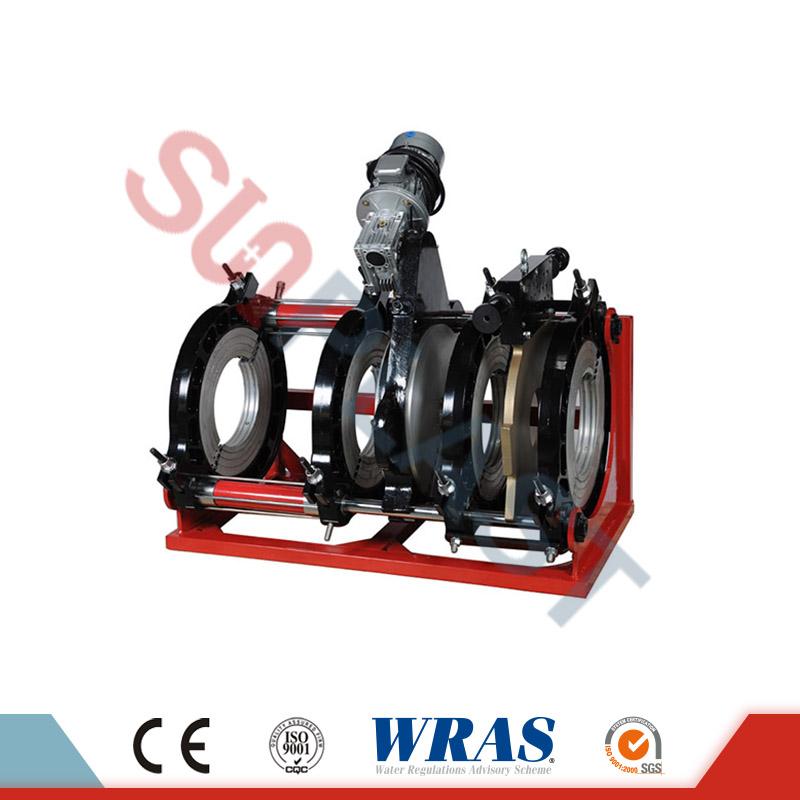
Why Is Mechanical Safety Integrity Critical in an HDPE Pipe Welding Machine?
The sheer physical force exerted by a modern HDPE Pipe Welding Machine demands absolute mechanical reliability. We are not merely clamping plastic; we are generating thousands of pounds of force to face the pipe ends and then pressing them together with micron-level precision. The first standard we adhere to is the structural soundness of the frame. Our factory utilizes high-grade steel alloys that undergo stress-relieving heat treatment. This prevents micro-fractures that can develop from the repetitive hydraulic cycling common in trench environments. A substandard frame flexing under load changes the alignment geometry, leading to improper bead formation and, more dangerously, a catastrophic release of stored kinetic energy if a clamp fails.
The hydraulic systems must meet stringent leakage prevention protocols. A burst hose or a leaking cylinder on a hot jobsite is a severe burn and slip hazard. We only integrate hoses that exceed SAE 100R2AT ratings, ensuring they withstand pressure spikes well beyond the machine’s maximum operating capacity. Furthermore, the clamping inserts are machined to prevent the "slip-stick" phenomenon. If a pipe slips during the cooling cycle, the operator faces a high-risk situation of trying to correct a semi-molten joint. Our design incorporates a redundant locking mechanism that physically prevents clamp retraction until pressure is manually bled, a feature directly addressing a common failure point we observed in field returns from less rigorous manufacturers.
How Do Electrical and Thermal Standards Prevent Jobsite Accidents?
When asking what safety standards HDPE pipe welding equipment should meet, the conversation must turn immediately to the interplay between electricity and heat. A typical HDPE Pipe Welding Machine integrates a heater plate operating constantly at around 400°F (204°C) to 450°F (232°C) alongside sophisticated digital control units. We design our equipment with a dual-isolation electrical architecture. This means the control logic operates on low-voltage circuits strictly segregated from the high-load heating elements, drastically minimizing the risk of a live chassis. Our factory standards mandate an Ingress Protection rating of at least IP54 for all control units, ensuring that dust and splashing water from a sudden rainstorm on a trenching site do not cause a short circuit.
Thermal management is equally vital. The non-stick coating on our heater plates is not just for clean removal; it is a critical safety layer. A scratched or low-quality PTFE coating can cause molten polymer to adhere to the aluminum, creating a fire hazard when it smokes and degrades. We utilize a multi-layer, industrial-grade coating tested to prevent degradation at temperatures 20% higher than the standard operating range. Additionally, the thermal runaway protection embedded in our digital controllers is non-negotiable. If a thermocouple fails in the "on" position on a cheaper HDPE Pipe Welding Machine, the plate can glow red hot. Our logic loops require a constant fluctuation signal from dual thermocouples; if the differential falls outside a 2°C window, the system executes a hard cut-off, eliminating a significant fire risk inherent in unattended pre-heating cycles.
Why Does the ISO 21307 Standard Dominate Our Fusion Protocol Development?
While regional regulations vary, the international consensus standard ISO 21307 forms the absolute backbone of the safety and quality programming inside our equipment. This standard defines the three fundamental fusion procedures: single pressure, dual low pressure, and dual high pressure. The safety implication here is directly tied to operator error reduction. We embed these protocols directly into the firmware of our automatic HDPE Pipe Welding Machine lineup. Instead of a novice operator guessing a pressure setting based on a field-worn chart, our logic calculates the interfacial pressure based on the exact pipe diameter and Standard Dimension Ratio (SDR) entered by the user, compensating for ambient temperature and drag resistance in real-time.
This traceability aspect is a critical safety net. Equipment built to ISO 21307 compliance must have data logging capabilities. We incorporate USB-exportable joint reports in our machines, recording the actual time, temperature, and pressure curves for every single joint. In the event of a hydrostatic test failure—which can be violent and dangerous in high-pressure gas lines—engineers can immediately audit whether the HDPE Pipe Welding Machine deviated from the set parameters. From our perspective as a manufacturer, building a machine that cannot rigidly replicate these procedures is a liability. That is why Sunplast validates the weld integrity of our equipment through extensive destructive testing in our lab, ensuring the automated cycles consistently produce beads that exhibit the correct roll-back characteristics without brittle failure points.
How Does Compliance with ASTM F2620 Prevent Fusion Disasters?
For the North American market, the benchmark answering "what safety standards should HDPE pipe welding equipment meet" is firmly rooted in ASTM F2620. This is not a mere suggestion; it is the code of practice that governs the joining of polyethylene pipe. The standard places a heavy emphasis on the heating tool surface temperature and uniformity. A heater plate with cold spots creates a false sense of security—the surface thermometer reads 400°F, but a 2-inch area might be 350°F, resulting in a weak cold weld. Our factory tests every single heater plate with a thermal imaging camera to map the heat profile, rejecting any unit with a deviation greater than ±5°F across the welding surface.
ASTM F2620 also dictates the specific safe distance and alignment for facing tools. Our planers are designed with shielded cutting blades that expose only the precise segment necessary to shave the pipe end, preventing loose clothing or gloves from entanglement. We have also integrated a real-time feedback system for the 'melt bead roll-back' inspection standard described in the code. Our HDPE Pipe Welding Machine assists the operator in assessing the fusion process by calculating the actual travel distance of the carriage during the heating phase, comparing it to the theoretical displacement derived from the melt density. Ningbo Sunplast Pipe Co., Ltd. ensures that if a joint’s viscous flow falls outside the predicted parameters, the machine immediately flags the joint as suspect, enforcing the standard rather than passively hoping the operator notices an anomaly.
To better illustrate the technical specifications that directly correlate to these safety protocols, let’s examine the performance parameters of our core welding systems. These figures represent the tangible engineering outcomes of adherence to the standards discussed above.
| Specification Category | Parameter | Safety Standard Justification |
| Frame Rigidity | Hydraulic axial force tolerance: 20% above rated maximum; Deflection under load < 0.01 inch. | Exceeds ISO 21307 structural integrity requirements, preventing misalignment during high-pressure fusion. |
| Heater Plate Uniformity | Surface temperature variance < ±5°F across entire diameter (tested at 450°F). | Strictly complies with ASTM F2620 heat soak criteria to eliminate cold-weld risks. |
| Electrical Safety | IP65-rated control console; Dual-isolation transformer; Emergency stop with safety relay (Category 3). | Meets NFPA 70 and IEC 60204-1 for prevention of arc flash and wet-environment shock. |
| Data Traceability | 500-joint internal memory; USB export of pressure/time/temperature curves. | Enforces ISO 21307 record-keeping for audit trails and safety validation. |
What Role Do Certifications and Data Traceability Play in Operator Safety?
The narrative that a machine is safe simply because it has a "CE" sticker on the side is dangerously incomplete. True certification for an HDPE Pipe Welding Machine means it has passed third-party evaluations of its internal logic boards for electromagnetic compatibility (EMC). We discovered early in our manufacturing journey that high-frequency radio noise from job site generators could corrupt the CPU logic of sensitive pressure transducers, causing erratic carriage movements. Therefore, our equipment undergoes rigorous EMC testing to ensure the electronics are immune to such interference.
Data traceability serves as the silent guardian of long-term safety. A joint that visually looks acceptable but was welded with a momentary 5-second pressure interruption is a deferred catastrophe, especially in pressurized gas applications. We integrate GPS stamping and operator ID login as standard features in our advanced models. This ensures individual accountability and, more importantly, provides forensic evidence. In the regrettable instance of a pipeline failure, the ability to instantly retrieve the digital birth certificate of every joint from the HDPE Pipe Welding Machine drastically reduces the time a dangerous leak goes undiagnosed. Ningbo Sunplast Pipe Co., Ltd. views this traceability not as an optional upgrade but as a fundamental right of the pipeline owner and the community living near the infrastructure.
| Safety Feature | Technical Implementation | Industry Alignment |
| Automatic Datalogging | Inbuilt USB interface with proprietary Windows-compatible software for generating PDF reports. | Required by ASTM F2620 Section 9 for verifiable joint integrity. |
| Emergency Intervention | Fused disconnect switch and mushroom-head emergency stop; solenoid dump valves to retract carriage. | IEC 60204-1 safety functions for immediate energy isolation. |
| Coating Integrity | Multi-layered, reinforced non-stick surface with visual wear indicators embedded in the PTFE. | Prevents molten HDPE adhesion and smoke toxicity hazards. |
| Calibration Drift Prevention | Hydraulic pressure transducer with digital auto-zeroing on startup and temperature compensation. | Ensures interfacial pressure accuracy per ISO 21307 procedural tables. |
Frequently Asked Questions
Q1: What Safety Standards Should HDPE Pipe Welding Equipment Meet for Gas Distribution Projects?
For gas distribution, the essential standards go beyond basic construction quality. Equipment must strictly conform to ASTM F2620 in the United States, or ISO 21307 internationally, but with additional operator qualification requirements. The critical safety standard here involves the machine's ability to accurately execute the "dual pressure" protocol, ensuring the low-pressure soak phase eliminates gaseous voids at the interface. The heater plate surface temperature uniformity is also paramount; a deviation can create a brittle joint susceptible to rapid crack propagation under pressure. Our factory ensures that all components, from the hydraulic hoses to the terminal blocks, are rated for the ATEX or equivalent North American hazardous location requirements, preventing any spark risk during fusion operations near gas lines.
Q2: What Safety Standards Should HDPE Pipe Welding Equipment Meet Regarding Electrical Shock Prevention?
The critical electrical safety standards focus on protecting the operator from ground faults in wet excavation conditions. Equipment should meet the insulation resistance tests described in IEC 60204-1. We ensure our HDPE Pipe Welding Machine incorporates a residual current device (RCD) or ground fault circuit interrupter (GFCI) that trips at a leakage current no greater than 30mA. Furthermore, the heater plate design must feature a physical, heat-resistant guard that prevents direct contact with the aluminum surface; it is not enough to paint the surface, as paint wears away. The standard also dictates a hard-wired emergency stop circuit that directly cuts power to the contactors through an electromechanical safety relay, failing safe instantly without waiting for a software command to process.
Q3: What Safety Standards Should HDPE Pipe Welding Equipment Meet to Guarantee Data Integrity?
Data integrity standards are safety standards because a faulty record can mask a defective weld. The primary requirement is that the system must not allow manual overwriting of critical parameters during the fusion cycle. The standard we follow ensures the HDPE Pipe Welding Machine creates an immutable, time-stamped record that captures the actual melt pressure (not just the command signal). This requires calibrated, closed-loop feedback sensors that sample at a minimum rate of 1 Hz. The machine must also meet resistance to voltage brownouts without corrupting the flash memory; we design our power supplies with sufficient hold-up capacity to save and shut down gracefully if the generator runs out of fuel, preserving the safety record of the joint just completed.
Selecting the right fusion equipment ultimately means selecting a partner committed to the unforgiving rigor of pipeline safety. The standards we embed into every unit that leaves our factory represent decades of learning from field failures, listening to pipeliners, and refusing to cut corners on steel or silicon. Whether you are tackling municipal water mains or high-stakes gas distribution, the reliability of your HDPE Pipe Welding Machine directly defines the safety of the buried network. We invite you to contact our engineering team today to discuss your specific project requirements and discover how our standards-aligned equipment can deliver not just fused pipes, but peace of mind.