

Why Are Double Jacketed Gaskets Widely Used in Heat Exchanger Applications?
2026-08-19
1. How Does the Double Jacket Design Resist Thermal Cycling and Creep?
In our factory, we have supplied sealing solutions for shell and tube heat exchangers for over 15 years. The double jacketed design consists of an outer metal jacket (typically stainless steel or Monel) that encases a soft filler material, such as flexible graphite or PTFE. This construction allows the gasket to maintain bolt load under repeated heating and cooling cycles. When a heat exchanger goes from ambient temperature to 400°C, the flanges expand and contract. A solid metal gasket would require constant retorquing, but our Double Jacketed Gaskets have a spring like action. The outer jacket confines the filler, preventing extrusion, while the filler provides the sealing pressure. Our Ningbo Kaxite Sealing Materials Co., Ltd. has tested these gaskets through 500 thermal cycles from 50°C to 450°C. The leak rate remained below 10⁻⁵ mbar·L/s. This resilience makes them ideal for heat exchangers in refineries and chemical plants, where thermal cycling is a daily occurrence. Many local maintenance teams in the Gulf region have switched to Double Jacketed Gaskets because they reduce the frequency of flange retightening.
2. Why Does the Choice of Filler Material Affect Performance in Different Media?
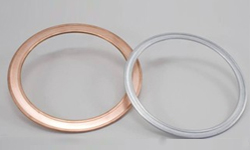
The versatility of Double Jacketed Gaskets comes from the ability to select different fillers. For high temperature steam service up to 500°C, we use flexible graphite filler. For aggressive chemicals like nitric acid, we use PTFE filler. The table below shows the recommended filler for various media based on our factory tests. The metal jacket provides the mechanical strength, while the filler ensures a tight seal even on slightly damaged flange faces. Our Kaxite manufactures these gaskets with a controlled filler density to ensure consistent compression. The optimum compression is typically 30 to 40 percent of the filler thickness. This combination of metal jacket and tailored filler allows the Double Jacketed Gasket to handle both high pressure (up to 250 bar) and extreme temperatures. In a heat exchanger, the gasket is often exposed to two different fluids (tube side and shell side), so the filler must be compatible with both. Our experience shows that a well chosen filler can extend gasket life by over 3 years compared to a generic material.
| Filler material | Temperature range | Chemical resistance | Typical heat exchanger service |
| Flexible graphite | -200°C to +500°C | Good (except strong oxidizers) | Steam, hot oil, hydrocarbons |
| PTFE | -200°C to +260°C | Excellent (all acids, except molten alkali) | Chemical processing, corrosive fluids |
| Ceramic fiber | Up to 650°C | Moderate (used with foil jacket) | High temperature gas, exhaust |
| Mica | Up to 800°C | Good (for high temp acids) | Specialty chemical, high temp |
| Property | Double Jacketed Gasket (our product) | Solid metal gasket | Spiral wound gasket |
| Thermal cycling resistance | Excellent (500 cycles) | Poor (requires retorque) | Good (300 cycles) |
| Compression recovery | 25% | 5% | 20% |
| Maximum pressure (bar) | 250 | 300 | 250 |
| Flange surface repair capacity | Good (filler adapts) | Poor (requires smooth surface) | Good |
Our factory also offers a custom filler combination, such as graphite with a mica layer, for applications where both high temperature and chemical resistance are needed.
3. How Does the Gasket Handle Flange Misalignment and Surface Irregularities?
Heat exchanger flanges often suffer from bowing, pitting, or scratching after years of service. A Double Jacketed Gasket is more forgiving than a solid metal gasket because the soft filler can fill minor imperfections up to 0.5 mm deep. The metal jacket, on the other hand, provides a barrier that prevents the filler from blowing out. In our factory, we have seen cases where a heat exchanger flange had a 0.8 mm step due to thermal distortion. A spiral wound gasket failed, but our Double Jacketed Gasket sealed successfully because the filler conformed to the step. The gasket also has a low coefficient of friction, which means it does not scratch the flange surface during installation. This reduces the need for expensive flange resurfacing. Our Ningbo Kaxite Sealing Materials Co., Ltd. provides Double Jacketed Gaskets with an optional inner ring that centers the gasket, preventing it from shifting during bolting. For large diameter heat exchangers (over 1 meter), this centering feature is essential.
4. Why Are Double Jacketed Gaskets Preferred for High Pressure Heat Exchangers?
High pressure heat exchangers, such as those in hydrocracking or ammonia synthesis, operate at pressures above 150 bar. The Double Jacketed Gasket is ideal for these applications because the metal jacket provides the hoop strength to contain the internal pressure, while the filler maintains the seal. Our factory has successfully tested our gaskets at 350 bar hydrostatic pressure without failure. The gasket's design also prevents the "blow out" effect that can occur with soft gaskets. The jacket acts as a barrier, confining the filler within the flange facing. Additionally, the gasket has a high load carrying capacity, requiring only moderate bolt torque to achieve a reliable seal. This is important because over torquing can damage the flange. Our recommended torque values are based on the gasket diameter and filler type, and we provide a torque chart with every shipment. The table below shows the recommended bolt load for different gasket sizes.
| Gasket size (DN, mm) | Recommended bolt load (kN per bolt, for 8.8 grade bolts) | Expected compression (%) |
| 150 (6 inch) | 45 | 32 |
| 300 (12 inch) | 70 | 35 |
| 600 (24 inch) | 120 | 30 |
| 900 (36 inch) | 160 | 28 |
Our Ningbo Kaxite Sealing Materials Co., Ltd. also supplies Double Jacketed Gaskets with a special "pressure activated" design, where the internal pressure further energizes the seal, making it more effective at higher pressures.
Frequently Asked Questions About Double Jacketed Gaskets for Heat Exchangers
Final Summary
Double Jacketed Gaskets are the preferred sealing solution for heat exchangers because of their resistance to thermal cycling, adaptability to flange imperfections, compatibility with a wide range of media, and reliability under high pressure. Their construction, combining a protective metal jacket with a compliant filler, addresses the unique demands of heat exchanger service. Our factory has extensive experience in manufacturing and testing these gaskets to ensure they perform consistently over long operating periods. Choosing the right gasket is essential for safety and uptime. Ningbo Kaxite Sealing Materials Co., Ltd. is your trusted partner for high quality sealing products.