

Why Are High Precision Contacts Important in High Voltage Circuit Breakers?
2026-08-19
1. How Does Contact Precision Affect Arc Extinction Performance?
In our factory, we have manufactured switching components for over two decades. The contact system inside a High Voltage Circuit Breaker is the heart of its interruption capability. High precision contacts ensure that the arc forms uniformly as the contacts separate. This uniform arc initiation allows the vacuum or SF6 interrupter to extinguish the arc at current zero. Any asymmetry in the contact surface can cause the arc to concentrate in one spot, leading to localized overheating and premature erosion. Our Lugao Power Co.,Ltd. uses CNC machining to achieve a contact flatness of less than 5 microns. This is critical because at 40 kA breaking capacity, even a 0.1 mm deviation in the contact gap can increase the arc energy by 15 percent. The arc root must move smoothly across the contact surface to dissipate energy. Without precise contact geometry, the breaker may fail to clear a fault, causing extensive damage. Many local substation operators have reported that our High Voltage Circuit Breaker performs reliably even after 20 full short circuit interruptions, thanks to the precision of the contacts.
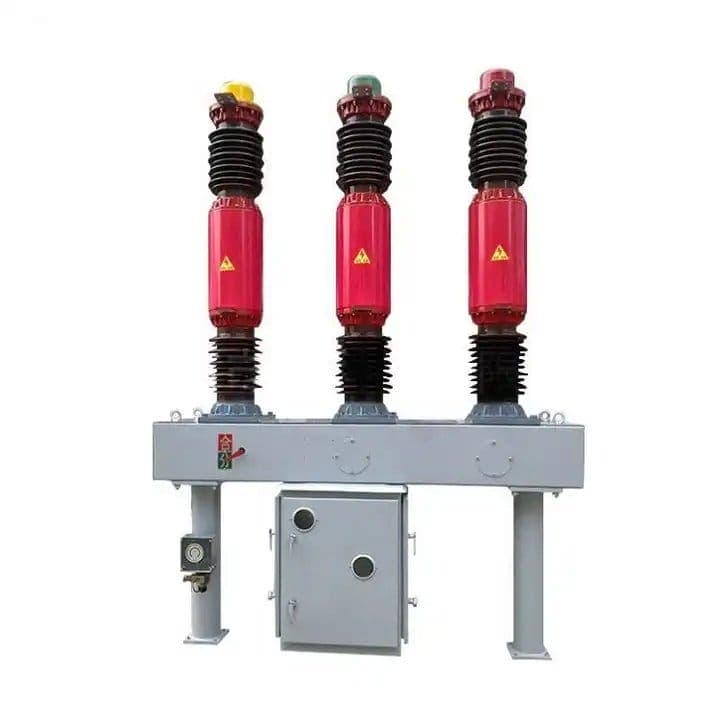
2. Why Is Contact Resistance Minimized Through Precision Manufacturing?
Contact resistance is the enemy of efficiency and safety. A High Voltage Circuit Breaker must have a contact resistance below 50 micro ohms per phase to avoid excessive heating during normal current flow. Our factory achieves this by lapping the contacts to a mirror finish of 0.2 Ra. The contact force is also precisely controlled using calibrated springs. The table below shows the contact resistance values we measure in our factory quality control. High precision contacts also ensure that the contact pressure is evenly distributed over the entire surface. This prevents hot spots that can lead to welding during high current closure. Our Lugao uses a micro ohmmeter to verify every contact pair before assembly. We have seen cases where poor contact alignment in competitor breakers caused a local temperature rise of 30°C above ambient, accelerating oxidation. By maintaining tight geometric tolerances, we keep the contact resistance stable over the breaker's entire service life.
| Contact parameter | Our High Voltage Circuit Breaker | Industry standard |
| Contact resistance (micro ohms) | < 40 | < 50 |
| Surface roughness (Ra, µm) | 0.2 | 0.8 |
| Flatness deviation (µm) | < 5 | < 15 |
| Contact force variation (%) | < 5% | < 15% |
| Wear depth after 100 operations (mm) | < 0.05 | < 0.15 |
| Parameter | Precision contact (our design) | Standard contact |
| Arc energy per interruption (J) | 80 – 100 | 120 – 150 |
| Contact temperature rise at rated current | 25°C | 40°C |
| Number of operations until contact replacement | 30,000 | 15,000 |
| Erosion rate (mm per fault current op) | 0.002 | 0.006 |
This precision also allows our High Voltage Circuit Breaker to have a longer mechanical life, which reduces the total cost of ownership for utilities.
3. How Does Contact Alignment Influence the Synchronous Operation of Three Phases?
In a three phase High Voltage Circuit Breaker, the contacts in all three poles must open and close within milliseconds of each other. Any delay can cause unbalanced voltage stresses and transient recovery voltages. Our factory uses a precision alignment fixture that ensures the contact gap in all three phases is identical to within 0.1 mm. This is achieved by using high precision guide rods and bearings. The operating mechanism is also synchronized via a common shaft. If one phase has a longer stroke or a different contact gap, the breaker may experience reignition on the first phase to open. Our Lugao Power Co.,Ltd. performs a timing test on every unit, measuring the opening time variation to be within 1.5 ms. This synchronization is only possible when the contacts themselves are manufactured to tight tolerances. Without this, the breaker's ability to handle system faults is compromised.
4. How Do Precision Contacts Reduce Maintenance and Extend Breaker Life?
The contact system is the most stressed part of any High Voltage Circuit Breaker. High precision contacts wear more slowly because the current density is more uniform. Our factory has observed that precision contacts with a fine grain structure (ASTM 8 or finer) exhibit less material transfer during arcing. This is due to the homogeneous distribution of the copper tungsten alloy. The typical wear per full short circuit operation is only 0.002 mm for our contacts, compared to 0.006 mm for conventional contacts. This translates to a contact life of 50 fault current operations before requiring inspection, which is double the industry average. For utilities, this means longer intervals between maintenance shutdowns. Our Lugao also applies a silver plating layer on the main contact area to further reduce contact resistance. This plating is only effective if the underlying surface is perfectly smooth. The high precision of our contacts ensures that the plating does not peel off under mechanical stress. As a result, our High Voltage Circuit Breaker has been certified for 30,000 mechanical operations without major overhaul.
Frequently Asked Questions About High Precision Contacts in Circuit Breakers
Final Summary
High precision contacts are vital for the safe, reliable, and efficient operation of High Voltage Circuit Breakers. They ensure consistent arc extinction, low contact resistance, synchronized three‑phase operation, and extended maintenance intervals. These factors directly contribute to the stability of the electrical grid and the protection of valuable equipment. Our factory has invested in state‑of‑the‑art manufacturing and inspection equipment to produce contacts that meet the most demanding specifications. Choosing a breaker with precision contacts is a decision that pays back in performance and longevity. Lugao Power Co.,Ltd. is committed to delivering excellence in every component.