

Why Are Shaft Collars Essential for Load-Bearing Applications?
2026-02-25
How Do Shaft Collars Secure Axial Loads in Industrial Power Systems?
In heavy-duty mechanical assemblies, controlling axial movement along a rotating shaft is critical for safety, durability, and precision. Shaft collars function as mechanical stops, load-bearing supports, and component positioning devices in a wide range of industrial systems. In North American and European markets, engineers frequently refer to them as shaft locking collars or shaft retaining collars, particularly in load-rated assemblies where torque transmission and axial restraint must work together.
In load-bearing applications, shaft collars are installed to prevent components such as sprockets, pulleys, bearings, and couplings from shifting under thrust loads. Without a properly rated collar, axial displacement can result in premature bearing wear, misalignment, or catastrophic failure. This is especially true in conveyor drives, agricultural implements, packaging equipment, and automated production lines.
As part of our Transmission Products portfolio, our shaft collars are engineered for consistent holding power, precise bore tolerance, and dependable clamping force. Our factory focuses on high concentricity and tight dimensional control to ensure every collar delivers stable axial retention even under vibration and shock loading.
Raydafon Technology Group Co., Limited has supplied industrial power transmission components for global OEM and aftermarket clients who require predictable load performance and long-term reliability in real working environments.
Why Does Collar Design Influence Load Capacity and Equipment Reliability?
The load-bearing capability of a shaft collar is determined by several factors: design type, material grade, surface finish, and tightening mechanism. In real-world engineering practice, two primary styles dominate load-bearing systems: set screw collars and clamp type collars.
Set screw collars are widely used in light to medium-duty assemblies. They rely on point contact between the screw and shaft surface. While economical, they can create shaft marring and reduced holding consistency under high axial thrust.
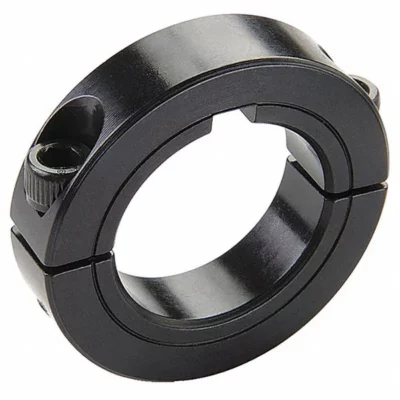
Clamp style collars, often called split shaft collars in local terminology, distribute clamping force evenly around the shaft circumference. This design improves concentricity and increases axial holding strength without damaging the shaft. For heavy-duty load-bearing systems, clamp collars are generally preferred.
Our engineering team recommends selecting the collar style based on torque rating, shaft hardness, operating speed, and environmental exposure. In high-load assemblies, improper collar selection can compromise bearing preload and introduce mechanical vibration. Within our Transmission Products range, we provide both single split and double split clamp collars to accommodate varying load demands.
What Technical Parameters Define a Reliable Load-Bearing Shaft Collar?
For engineers and procurement managers, performance validation is based on measurable parameters rather than appearance. Our factory manufactures shaft collars with strict quality control to meet industrial load requirements across agricultural machinery, material handling systems, and automation equipment.
| Parameter | Specification Range |
| Bore Diameter | 6 mm to 200 mm |
| Material Options | Carbon Steel, Alloy Steel, Stainless Steel 304 and 316 |
| Surface Treatment | Black Oxide, Zinc Plated, Nickel Plated, Phosphate Coating |
| Tensile Strength | Up to 800 MPa depending on material grade |
| Operating Temperature | Minus 30 degrees Celsius to 300 degrees Celsius |
| Bore Tolerance | H7 precision standard |
These parameters directly affect axial load resistance and long-term mechanical stability. High tensile strength materials improve structural integrity, while precision bore tolerance ensures tight shaft engagement. For corrosion-prone or washdown environments, stainless steel collars provide enhanced durability.
As a professional manufacturer of Transmission Products, we maintain consistent machining accuracy and torque verification during production. Raydafon Technology Group Co.,Limited ensures each collar meets dimensional repeatability standards required by industrial OEM clients.
How Do Shaft Collars Integrate with Broader Load-Bearing Transmission Systems?
In practical industrial assemblies, shaft collars rarely operate alone. They function as integral components within broader Transmission Products systems, working alongside couplings, sprockets, bearings, and gear assemblies. Their primary role is to maintain positional stability while allowing torque to transfer efficiently across rotating elements.
For example, in conveyor drive systems, collars are installed adjacent to bearings to prevent axial drift. In agricultural PTO assemblies and rotary equipment, they maintain implement positioning under fluctuating field loads. In servo-driven automation systems, they help preserve alignment tolerances essential for precision motion control.
Our factory emphasizes compatibility engineering to ensure that our shaft collars align with standard shaft diameters used in ANSI and ISO mechanical systems. This reduces installation errors and simplifies maintenance procedures for technicians in the field.
| Application Sector | Typical Load Condition | Recommended Collar Type |
| Conveyor Systems | Moderate axial thrust with vibration | Single Split Clamp Collar |
| Agricultural Equipment | High shock load and dust exposure | Double Split Heavy Duty Collar |
| Automation Lines | Precision positioning with low backlash | Stainless Steel Clamp Collar |
| Packaging Machinery | Continuous operation load | Black Oxide Carbon Steel Collar |
Through controlled production and strict inspection, Raydafon Technology Group Co.,Limited supplies shaft collars designed for long service life within industrial Transmission Products assemblies.
What Factors Should Engineers Consider When Selecting Shaft Collars for Load-Bearing Applications?
Selecting the correct shaft collar requires evaluating axial load rating, shaft surface hardness, rotational speed, environmental conditions, and maintenance intervals. Overlooking any of these factors can reduce holding performance.
Our technical recommendation process includes confirming shaft diameter tolerance, verifying expected axial force, and matching collar material to operating temperature. For heavy load conditions, we advise clamp type collars with high-strength alloy steel construction.
As a global supplier of Transmission Products, we support OEM customization, including special bore sizing, keyway integration, and corrosion-resistant coatings. Our factory also provides torque reference data to ensure correct installation tightening force.
Raydafon continues to optimize machining accuracy and surface finishing processes to deliver dependable shaft collars for industrial buyers worldwide.
Frequently Asked Questions
Q1: Why Are Shaft Collars Essential for Load-Bearing Applications?
A1: Shaft collars are essential because they prevent axial movement of rotating components under thrust load. In load-bearing assemblies, even minor axial displacement can cause bearing misalignment, uneven wear, or mechanical vibration. A properly selected collar secures components firmly on the shaft, stabilizes mechanical alignment, and extends overall equipment life. Without a load-rated collar, power transmission systems may experience premature failure or reduced operational efficiency.
Q2: Why Are Shaft Collars Essential for Load-Bearing Applications in High-Vibration Environments?
A2: In high-vibration environments such as agricultural machinery or material handling systems, constant shock loads can loosen improperly designed collars. Clamp style collars distribute pressure evenly around the shaft, improving grip stability and maintaining concentricity. This prevents gradual axial drift and protects bearings and couplings from misalignment damage. Selecting the right material and surface finish further enhances resistance to vibration-induced wear.
Q3: Why Are Shaft Collars Essential for Load-Bearing Applications Compared to Alternative Retention Methods?
A3: Compared to retaining rings or adhesive bonding methods, shaft collars offer adjustable positioning, higher load capacity, and easier maintenance. They allow technicians to reposition components without specialized tools and provide stronger axial restraint in heavy-duty systems. For industrial Transmission Products assemblies, collars deliver a balance of flexibility, durability, and mechanical reliability that alternative solutions often cannot achieve.
In load-bearing mechanical systems, shaft collars play a decisive role in maintaining axial stability, protecting bearings, and preserving alignment accuracy. From conveyor drives to agricultural equipment and automated production lines, their performance directly influences equipment reliability and safety. At Raydafon Technology Group Co.,Limited, we manufacture high-precision shaft collars within our complete Transmission Products line, combining material strength, machining accuracy, and global supply capability. If you are seeking durable load-rated shaft collars for your industrial application, contact our team today to request specifications or a customized quotation tailored to your project requirements.