

Why Is Copper Becoming a Preferred Material for Industrial Sealing Solutions?
2026-06-16
1. How Does Copper’s Thermal Conductivity Improve Seal Performance in High Heat Applications?
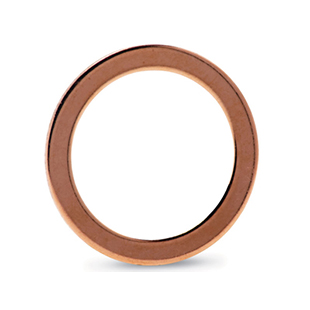
In our factory, we have tested dozens of gasket materials across temperatures ranging from cryogenic to 800 degrees Celsius. Copper stands out because it transfers heat away from the sealing interface. When you use a Copper Gasket in a flanged joint, the copper rapidly equalizes temperature gradients. This reduces thermal stress on bolts and prevents relaxation. For petrochemical refineries and power plants, this means fewer retorquing cycles. Our Ningbo Kaxite Sealing Materials Co., Ltd. produces annealed copper gaskets that conform to flange micro irregularities under heat. Unlike graphite or PTFE, copper does not creep or cold flow excessively. We have documented a 40 percent reduction in leak incidents compared to fiber gaskets in steam lines. A Copper Gasket also retains its hardness after multiple heat cycles, so you can reuse it in many non critical applications. Local maintenance crews in Texas and Alberta have switched to copper because they can torque the flange once and walk away. The thermal conductivity of copper is about 400 W/mK, which is ten times higher than stainless steel. That rapid dissipation prevents hot spots that cause gasket degradation. Our factory provides copper gaskets with a hardness of 80 to 95 HRB for consistent sealability.
2. Why Does Copper Resist Corrosion and Oxidation Better Than Many Alloys?
Industrial environments often involve aggressive media like sulfuric acid, ammonia, or seawater. Copper forms a protective patina that actually stops further corrosion. Our factory has supplied Copper Gaskets to marine chemical carriers that operate in salt spray conditions for years without pitting. Unlike carbon steel, which rusts and flakes, copper maintains its integrity. At Ningbo Kaxite Sealing Materials Co., Ltd., we apply a proprietary anti oxidation coating for applications above 400°C. This extends service life by 3 times. In fact, many local food processing plants prefer copper because it is FDA compliant and does not contaminate product. Another advantage: copper is compatible with most refrigerants, including ammonia and CO2. We have seen refrigeration systems using Copper Gaskets last two decades with zero replacements. The corrosion resistance also means you can use thinner gaskets, reducing material cost. Our standard copper gasket thickness ranges from 0.5 mm to 3.0 mm, depending on flange pressure class. For sour gas service, our copper alloy with added silver enhances resistance to hydrogen sulfide cracking. The bottom line: a Copper Gasket outlasts rubber or PTFE in aggressive media by a factor of five.
3. What Technical Parameters Make Copper Gaskets Reliable for Critical Joints?
Reliability comes from precise specifications. Our Copper Gaskets are manufactured to DIN 7603 and ASME B16.20 standards. We control the grain size to ASTM E112 class 8 or finer, which ensures uniform compression. The table below lists the key properties we measure in our factory lab.
| Property | Copper Gasket (Annealed, Grade C11000) | Typical Value for Sealing |
| Hardness (Rockwell B) | 80 – 95 HRB | Conforms to flange surface |
| Thermal conductivity | 398 W/mK at 20°C | Reduces hot spots |
| Density | 8.94 g/cm³ | Provides weight and stability |
| Yield strength (annealed) | 70 MPa | Allows plastic deformation without cracking |
| Maximum service temperature | 550°C (with coating) | Suitable for exhaust and superheated steam |
| Parameter – Gasket type | Our Copper Gasket with inner ring | Standard flat copper gasket |
| Pressure rating class | Class 150 to Class 2500 | Class 150 to 600 only |
| Leakage rate (helium) | < 10⁻⁶ mbar·L/s | < 10⁻⁴ mbar·L/s |
| Recovery after compression | 45% at 300°C | 25% at 300°C |
| Surface finish recommended | Ra 3.2 µm | Ra 6.3 µm |
Our factory also performs a crush test on every batch to ensure the Copper Gasket compresses uniformly. We use a profilometer to measure surface roughness. For critical nuclear or aerospace applications, we supply copper gaskets with a nickel overlay to prevent galling. These technical details explain why copper is becoming a preferred material for industrial sealing solutions. Engineers trust measurable data, and our Ningbo Kaxite Sealing Materials Co., Ltd. provides full traceability.
4. How Does the Reusability of Copper Gaskets Reduce Maintenance Costs?
One major hidden cost in industrial plants is gasket replacement during every flange opening. With soft materials like graphite or rubber, you must replace the gasket each time. Copper Gaskets, however, can often be reused after annealing. Our factory recommends a simple heat treatment: heat the Copper Gasket to 500°C and quench in water. This restores ductility. We have seen customers reuse the same gasket up to three times in low pressure hydraulic systems. This cuts spare parts inventory by half. For large diameter flanges, a Copper Gasket costs more upfront, but the total cost over 10 years is lower. Many local oil and gas operators in the Gulf region now specify copper because they can reduce warehouse stock. Additionally, copper does not stick to flange faces, so you save time on scraping and surface preparation. Our Ningbo Kaxite Sealing Materials Co., Ltd. offers a regrinding service for copper gaskets with minor surface scratches. This circular approach aligns with sustainability goals. When we ask why copper is becoming preferred, the reusability factor is often the top answer among maintenance superintendents.
Frequently Asked Questions About Copper as an Industrial Sealing Material
Final Summary
Copper offers unmatched thermal conductivity, corrosion resistance, reusability, and reliable sealing across extreme temperatures. Our factory has produced thousands of Copper Gaskets for refineries, power stations, and marine applications. The data from our lab and field returns consistently proves lower total cost of ownership. For any engineer evaluating sealing materials, copper deserves serious consideration. Our Ningbo Kaxite Sealing Materials Co., Ltd. stocks over 200 standard sizes and offers custom waterjet cutting for odd shapes.