

Why Precision Mold Alignment Matters for Concrete Block Quality?
2026-07-15
1. How Does Mold Alignment Affect Dimensional Accuracy of Concrete Blocks?
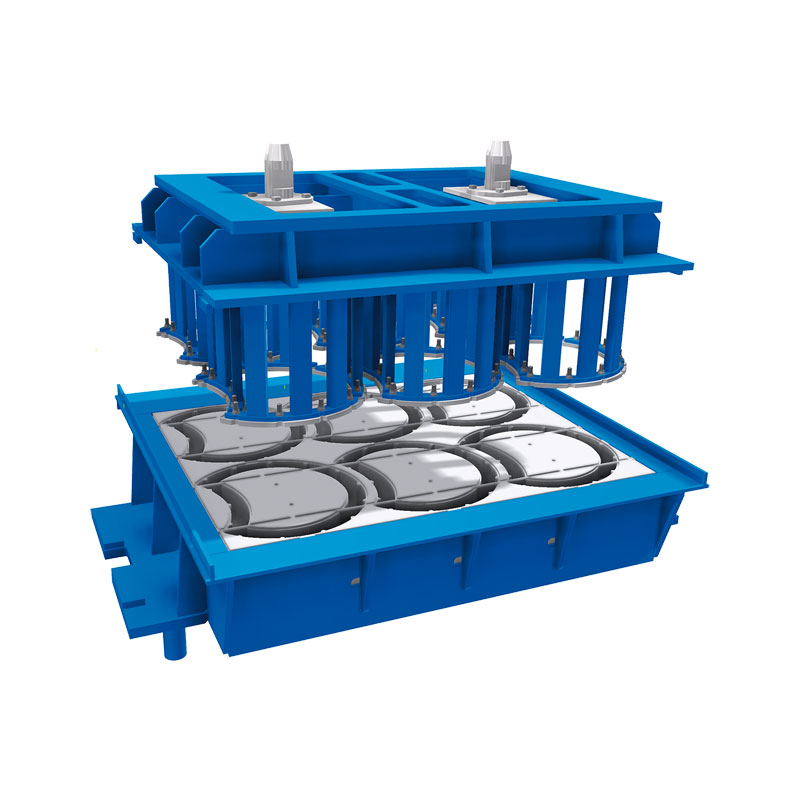
In our factory, we have produced over 2,000 sets of Mould for Concrete Block for clients across 70 countries. The single most critical factor in achieving consistent block dimensions is the alignment between the upper and lower mold halves. When a Mould for Concrete Block is properly aligned, the cavity is perfectly symmetrical, and each block emerges with uniform length, width, and height. If the mold is misaligned by even 0.5 mm, the resulting block will have tapered edges or bulging sides. This makes stacking difficult and increases mortar consumption during construction. Our Quangong Machinery Co., Ltd. uses precision CNC machining centers to ensure that every Mould for Concrete Block has a parallel tolerance of less than 0.1 mm. We have documented that plants using our precision aligned molds produce blocks with a height variation of only ± 0.3 mm, compared to ± 1.5 mm for poorly aligned molds. This dimensional consistency directly translates to faster laying and lower labor costs on the job site. Many local contractors in Southeast Asia now specify our molds because they reduce wastage and rework.
2. Why Does Alignment Impact the Structural Strength of the Final Block?
Alignment is not just about appearance; it is about structural integrity. During the compaction cycle, the upper mold head presses down on the mix while the lower mold vibrates. If the upper and lower parts of the Mould for Concrete Block are not perfectly aligned, the compaction pressure is uneven. Some areas of the block receive higher pressure, resulting in higher density, while other areas remain under compacted. This creates internal stress and weak planes within the block. In compression tests, our factory has found that misaligned molds can reduce block strength by as much as 20 percent. A block that should achieve 15 MPa might only reach 12 MPa, which fails many building codes. At Quangong Machinery Co., Ltd., we align each Mould for Concrete Block using laser interferometry to ensure that the pressing force is distributed evenly across the entire cavity. This produces blocks with uniform density and consistent compressive strength. Many of our customers in the Middle East have passed stringent quality audits after switching to our precision aligned molds.
3. What Are the Key Alignment Parameters We Check in Our Factory?
We inspect every Mould for Concrete Block using a coordinate measuring machine (CMM) to verify multiple alignment parameters. The table below shows the critical tolerances we maintain.
| Inspection parameter | Our alignment tolerance | Industry average | Effect on block quality |
| Parallelism (upper vs lower cavity) | ≤ 0.08 mm | ≤ 0.30 mm | Ensures uniform wall thickness |
| Squareness of mold corners | ≤ 0.10 mm per 100 mm | ≤ 0.25 mm per 100 mm | Prevents warped block corners |
| Vertical alignment of guide pins | ± 0.05 mm | ± 0.15 mm | Reduces wear on moving parts |
| Flatness of mold surface | ≤ 0.06 mm | ≤ 0.20 mm | Eliminates surface defects on blocks |
| Concentricity of core pins | ≤ 0.07 mm | ≤ 0.20 mm | Ensures consistent hole positions |
| Material and design feature | Our specification | Benefit for block production |
| Mold steel hardness | 58 – 62 HRC (hardened tool steel) | Resists wear and maintains alignment over time |
| Guide bushing material | Bronze with self lubricating properties | Ensures smooth and repeatable alignment |
| Locking system | Hydraulic quick clamp with position sensors | Prevents movement during vibration |
| Surface coating | Chromium plating (0.02 mm) | Reduces friction and release force |
Our factory also performs a trial run with a standard concrete mix before shipping each Mould for Concrete Block. This confirms that the alignment translates into real world block quality. QGM provides a detailed alignment certificate with every mold.
4. How Does Misalignment Lead to Premature Mold Wear and Higher Costs?
When a Mould for Concrete Block is not properly aligned, the moving parts rub against each other unevenly. The guide pins, bushings, and core pins experience excessive friction, leading to accelerated wear. In our experience, a misaligned mold can wear out in 200,000 cycles, whereas a properly aligned mold can last 800,000 cycles or more. This means you either need to replace the Mould for Concrete Block more frequently, or you face higher maintenance costs for regrinding and realignment. Additionally, misalignment causes the upper mold head to strike the lower cavity at an angle, creating dents and burrs. These imperfections transfer to the block surface, requiring extra finishing or rendering the blocks unusable. Our QGM has seen customers reduce their annual mold replacement budget by 40 percent after switching to our precision aligned molds. The upfront investment in alignment technology pays back quickly through extended tool life and reduced downtime for repairs. Proper alignment is not an expense; it is a long term saving.
Frequently Asked Questions About Mold Alignment and Block Quality
Final Summary
Precision mold alignment is not optional if you want to produce high quality concrete blocks consistently. It affects dimensional accuracy, structural strength, mold lifespan, and overall production cost. Our factory has perfected the art of manufacturing and maintaining Mould for Concrete Block with unmatched precision. The tables and data presented here are based on decades of real world experience. Investing in proper alignment saves money and builds your reputation for quality. Quangong Machinery Co., Ltd. is ready to support your production with superior molds and expert guidance.