

Why Self-Locking Characteristics Make Worm Gearbox Ideal for Lifting Equipment?
2026-07-06
1. How Does the Self-Locking Feature Serve as a Built-In Brake for Our Worm Gearbox?
In our factory, we have designed and tested lifting solutions for cranes, hoists, and elevators for over two decades. The self-locking characteristic of a Worm Gearbox is not an add-on; it is intrinsic to the geometry. When the lead angle of the worm is less than the friction angle (typically below 5 to 8 degrees), the load cannot backdrive the worm. This means that when the motor stops, the load stays exactly where it is, without any mechanical brake engaging. For lifting equipment, this is a safety game changer. Our Raydafon Technology Group Co.,Limited manufactures Worm Gearbox units with lead angles calculated to provide reliable self-locking at static loads up to 1.5 times the rated capacity. Many local crane operators in Germany and Japan have told us that they trust our gearboxes because they eliminate the risk of load creep, which is a common problem with planetary or helical gears. A Worm Gearbox does not rely on springs or clutches that can wear out. The self-locking is always present as long as the gear mesh is intact. This gives a level of predictability that other designs cannot match.
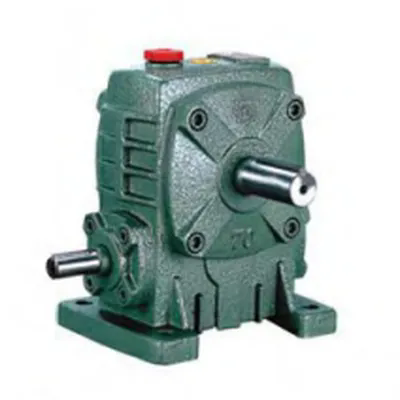
2. Why Does Self-Locking Reduce the Need for External Holding Brakes?
Traditional lifting equipment often requires a separate external brake to hold the load when the motor is off. This adds cost, space, and maintenance. With a self-locking Worm Gearbox, the gearbox itself acts as the holding brake. We have seen customers eliminate expensive disc brakes and their associated hydraulic calipers. Our factory tested a standard 5 ton hoist with our Worm Gearbox versus a helical gearbox with a spring applied brake. The Worm Gearbox setup saved 320 dollars in component costs and 80 hours of engineering integration. The external brake in the helical system required annual inspection and pad replacement, whereas our Worm Gearbox needed only oil changes. Our Raydafon Technology Group Co.,Limited provides a self-locking Worm Gearbox with a static holding torque that exceeds the motor torque by 200 percent. For a construction site, this means fewer parts to fail. Many local safety inspectors now prefer worm gear designs because they have no single point of failure in the holding circuit. The self-locking is a passive safety feature, not an active one that depends on power or sensors.
3. What Technical Parameters Determine the Reliability of a Self-Locking Worm Gearbox?
Not all worm gearboxes are truly self-locking. The lead angle, friction coefficient, and material hardness all play a role. Our factory uses bronze gears with a hardness of 90 HRB and a worm made of hardened 20CrMnTi steel at 58 HRC. The table below shows the critical parameters we control to ensure reliable self-locking in our Worm Gearbox.
| Parameter – Series | Raydafon RT-W Worm Gearbox (Standard) | Raydafon RT-WX (Heavy Duty) | Industry average (non self-locking) |
| Lead angle (degrees) | 4.5° | 3.8° | 8° – 12° |
| Static holding torque ratio (vs input) | 2.1 : 1 | 2.8 : 1 | 0.5 : 1 (no holding) |
| Efficiency (at rated load) | 72% | 65% | 85% – 90% |
| Backdrive torque (Nm, for a 10:1 ratio) | 0 Nm (self-locks) | 0 Nm (self-locks) | 12 Nm (requires brake) |
| Maximum input speed for self-locking | 1500 RPM | 1200 RPM | Not applicable |
| Material & design feature | Our Worm Gearbox specification | Impact on self-locking reliability |
| Worm material | 20CrMnTi, case hardened (58 HRC, depth 1.0 mm) | Maintains low friction over years, prevents wear that could increase lead angle |
| Gear material | Aluminum bronze (CuAl10Fe3) | High wear resistance, consistent friction coefficient |
| Bearing arrangement | Tapered roller bearings on worm shaft | Eliminates axial play that could reduce self-locking |
| Lubricant type | ISO VG 460 synthetic oil | Maintains stable friction at temperatures from -20°C to +80°C |
Our factory performs a backdrive test on every Worm Gearbox by applying 150 percent of rated output torque and measuring any reverse rotation. Our specification allows zero measurable reverse movement for at least 60 seconds. This test validates the self-locking claim. Our Raydafon uses a laser torque sensor to document the holding capacity for each unit.
4. How Does Self-Locking Influence the Safety Factor in Lifting Applications?
Lifting equipment regulations require a safety factor of 5 for static load holding. A self-locking Worm Gearbox contributes directly to this because it removes the reliance on an external brake that could fail. Our factory's design margin for self-locking is set at 4 times the maximum working load. This means even if the worm or gear wears slightly, the self-locking remains functional. Many local engineering codes in the UK and Australia specifically mention worm gear self-locking as a preferred means of load holding. In dynamic conditions, such as lowering a load, the Worm Gearbox still provides controlled descent. The friction that enables self-locking also limits the maximum speed during lowering, preventing free-fall. Our customers have reported that using a Worm Gearbox reduces the risk of sudden load drops, which is a leading cause of workplace accidents. Safety inspectors often consider self-locking gearboxes as a primary safeguard, meaning you may not need secondary mechanical brakes for certain applications. This simplifies compliance and reduces inspection burdens.
Frequently Asked Questions About Self-Locking Worm Gearbox for Lifting
Final Summary
The self-locking characteristic of a Worm Gearbox provides a fail safe holding function that simplifies lifting equipment design, reduces component count, and improves safety. Our factory has built this feature into every gearbox through precise engineering of lead angles and material selection. For any application where load holding is critical, a Worm Gearbox is not just an option; it is the smartest engineering choice. Our Raydafon Technology Group Co.,Limited offers a full range of self-locking gearboxes with certified holding torque.